
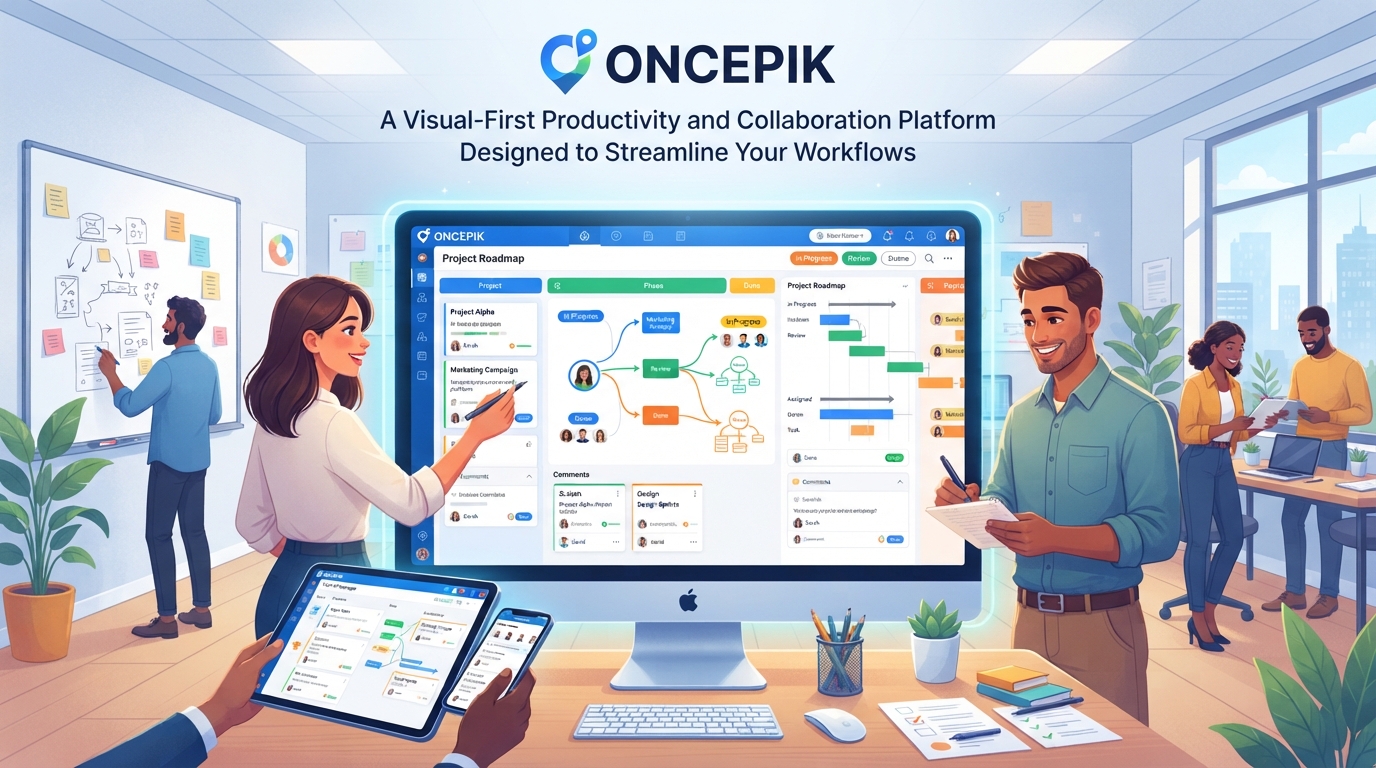
Modern organizations rely on efficient collaboration, clear communication, and well-structured workflows to achieve consistent results. As businesses embrace remote work, hybrid teams, and digital transformation, the need for intuitive productivity platforms continues to grow. oncepik has emerged as a visual-first productivity and collaboration platform designed to streamline workflows while making project management more engaging and accessible. Rather than overwhelming users with complicated interfaces, the platform emphasizes visual organization, allowing individuals and teams to understand tasks, priorities, and progress at a glance. This approach encourages better planning, smoother communication, and improved efficiency across projects of every size.
The increasing demand for collaborative software has inspired organizations to search for solutions that combine creativity with practical functionality. Visual organization not only simplifies information management but also reduces confusion that often arises in traditional task management systems. By integrating collaborative features into a unified environment, the platform supports professionals, educators, freelancers, and businesses seeking a more organized digital workspace.
Understanding the Purpose of oncepik
Every productivity platform aims to solve common workplace challenges, but visual collaboration introduces an entirely different perspective. Instead of focusing solely on text-based task lists, modern platforms arrange ideas, documents, conversations, and workflows into visually connected spaces. This method helps users understand relationships between projects while maintaining a clear overview of ongoing activities.
The philosophy behind this platform centers on simplifying complexity. Users can transform scattered information into structured visual boards that encourage collaboration and faster decision-making. Teams no longer need to switch constantly between multiple applications because important project components remain connected within one organized workspace.
The growing popularity of visual productivity tools reflects changing work habits. Employees increasingly value flexibility, transparency, and immediate access to information. A visual workspace reduces unnecessary searching, allowing more time for meaningful work rather than administrative tasks.
Table 1: Core Characteristics of Visual Productivity Platforms
| Feature | Business Value | User Benefit |
|---|---|---|
| Visual Workspaces | Better organization | Easy navigation |
| Team Collaboration | Faster communication | Improved coordination |
| Workflow Management | Increased efficiency | Clear task progress |
| Shared Resources | Centralized information | Reduced duplication |
| Project Tracking | Better visibility | Faster decision making |
oncepik and the Evolution of Digital Collaboration
Digital collaboration has evolved significantly over the past decade. Earlier workplace software primarily emphasized document sharing and messaging, leaving project organization as a secondary concern. Today, organizations expect productivity platforms to integrate communication, planning, documentation, scheduling, and reporting into one connected ecosystem.
This evolution reflects broader workplace trends where distributed teams require real-time access to accurate project information. Employees often work from different cities or countries, making centralized collaboration essential for maintaining productivity. Visual platforms bridge communication gaps by presenting information in an intuitive format that everyone can understand regardless of technical expertise.
Businesses also recognize that employee experience directly affects performance. When software is easier to navigate, users spend less time learning complex systems and more time contributing to organizational goals. Visual interfaces reduce cognitive overload while improving engagement throughout daily workflows.
Key Advantages of oncepik for Modern Teams
Organizations operate in increasingly competitive environments where speed and coordination determine success. A visual productivity environment helps teams remain aligned while adapting quickly to changing priorities. Instead of managing disconnected spreadsheets, emails, and chat messages, project information becomes centralized within one collaborative workspace.
One significant advantage involves transparency. Team members can easily understand project status without requesting frequent updates from colleagues. Managers gain better visibility into ongoing work while employees experience greater clarity regarding responsibilities and deadlines.
Creative industries particularly benefit from visual collaboration because brainstorming, design reviews, and content planning become more intuitive. Marketing agencies, software developers, educational institutions, and consulting firms often require environments where ideas evolve through continuous teamwork. Visual platforms naturally support this iterative process.
Another advantage lies in flexibility. Projects rarely follow identical structures, making adaptable workflows essential. Visual organization allows teams to customize workspaces according to project requirements while maintaining consistency across departments.
oncepik Features That Support Efficient Workflow Management
Effective workflow management depends on balancing organization with simplicity. Digital platforms should enhance productivity rather than introduce unnecessary complexity. Visual collaboration environments often achieve this balance by presenting tasks, timelines, files, and conversations within interconnected workspaces.
Collaboration extends beyond assigning responsibilities. Team members require opportunities to exchange feedback, monitor progress, share documents, and coordinate deadlines without switching between multiple systems. Integrated environments improve communication while reducing fragmented information.
Automation also contributes to efficient workflow management. Repetitive administrative activities can consume valuable time that employees could otherwise devote to strategic work. Automated notifications, progress updates, and status tracking reduce manual effort while improving consistency across projects.
As organizations continue embracing digital transformation, workflow visibility becomes increasingly valuable. Leaders require accurate information for planning resources, evaluating performance, and identifying improvement opportunities. Visual productivity systems provide clearer insights into project development while encouraging accountability throughout collaborative processes.
oncepik in Daily Project Coordination
Daily project coordination often becomes challenging when information is scattered across emails, spreadsheets, messaging applications, and shared drives. A visual-first workspace addresses this problem by bringing tasks, discussions, files, and timelines into a single environment. Team members can open a project board and immediately understand what is in progress, what has been completed, and what requires attention next. This clarity reduces delays caused by searching for updates or waiting for responses from colleagues.
Project managers benefit from a centralized overview of responsibilities and deadlines. Instead of manually collecting status reports from multiple team members, they can review progress directly within the workspace. Employees also gain confidence because expectations are visible and documented. When priorities change, adjustments can be reflected in the visual workflow, ensuring that everyone remains aligned without lengthy meetings.
The platform’s collaborative structure supports both synchronous and asynchronous work. Team members who are online at the same time can discuss tasks in real time, while others can review updates later without losing context. This flexibility is particularly valuable for organizations with remote or international teams operating across different time zones.
oncepik and Visual Workflow Design
Visual workflow design helps users transform abstract plans into structured processes. A project can begin as a collection of ideas and gradually evolve into defined stages with assigned responsibilities, deadlines, and supporting resources. By arranging work visually, teams can identify bottlenecks, overlapping responsibilities, and missing steps before they become serious problems.
The following table illustrates how visual workflow stages can improve operational clarity.
|
Workflow Stage |
Primary Focus |
Expected Outcome |
|---|---|---|
|
Planning |
Define objectives |
Clear project scope |
|
Organization |
Assign tasks |
Balanced workload |
|
Execution |
Track progress |
Timely completion |
|
Review |
Evaluate results |
Quality assurance |
|
Optimization |
Improve processes |
Greater efficiency |
By viewing workflows as connected stages rather than isolated tasks, teams develop a better understanding of how individual contributions affect overall project success. This perspective encourages accountability and helps organizations create repeatable processes that can be refined over time.
oncepik for Remote and Hybrid Work Environments
Remote and hybrid work environments require more than video conferencing and instant messaging. Teams need a shared operational space where information remains accessible regardless of location. Visual collaboration platforms provide this shared environment by allowing employees to contribute, review, and update work from any device with internet access.
In remote settings, visibility is essential. Employees should not feel disconnected from the broader project, and managers should not rely solely on meetings to understand progress. A visual workspace creates continuous awareness of team activity, reducing the need for constant check-ins while maintaining accountability.
Hybrid teams face an additional challenge because some employees work in the office while others participate remotely. A centralized digital workspace ensures that all team members have equal access to project information, discussions, and resources. This reduces the risk of communication gaps between in-office and remote participants and supports a more inclusive collaboration culture.
oncepik and Information Organization
Information overload is a common problem in modern workplaces. Documents, meeting notes, design files, research materials, and client communications can quickly become difficult to manage. Visual organization helps users categorize and connect related information so that important resources are easier to locate.
A structured workspace can function as a digital knowledge hub where teams store project documentation, reference materials, and historical decisions. New team members can review this information to understand project context without relying entirely on verbal explanations from colleagues. Over time, the organization builds a searchable repository of operational knowledge that supports continuity and reduces repeated work.
Effective information organization also improves decision-making. When relevant documents and discussions are connected to specific tasks or workflow stages, teams can evaluate options more efficiently and avoid confusion caused by outdated or duplicated files.
oncepik and Cross-Department Collaboration
Many organizational projects involve multiple departments working toward a shared objective. Marketing, design, product development, finance, and customer support teams often need to coordinate activities while maintaining visibility into each other’s progress. Visual collaboration environments make these interactions more transparent by allowing departments to share relevant workflow sections without exposing unnecessary information.
Cross-department collaboration becomes especially important during product launches, campaign planning, and strategic initiatives. Shared visual boards help teams understand dependencies, coordinate deadlines, and identify potential conflicts early in the process. This reduces the likelihood of last-minute surprises and encourages a more collaborative organizational culture.
The platform’s visual structure also helps non-technical stakeholders participate more confidently in project discussions. Executives, clients, and external partners can review progress through intuitive dashboards and workflow views, making communication clearer and more efficient for everyone involved.
oncepik and Creative Collaboration
Creative projects often involve multiple revisions, brainstorming sessions, and ongoing feedback between designers, writers, marketers, developers, and clients. Traditional communication methods can become fragmented when ideas are exchanged through lengthy email threads or disconnected messaging applications. A visual-first workspace creates an environment where concepts, drafts, comments, and supporting resources remain connected throughout the creative process.
Instead of searching through multiple conversations, collaborators can review project history directly alongside the work itself. This approach preserves context and makes it easier to understand why specific decisions were made. As ideas evolve, team members can compare different versions, refine concepts, and contribute suggestions without disrupting the overall workflow.
Creative collaboration also benefits from transparency. Everyone involved gains visibility into project milestones, approval stages, and upcoming deadlines. This clarity reduces misunderstandings while allowing creative professionals to focus on producing high-quality work rather than managing administrative tasks.
oncepik for Business Productivity
Business productivity depends on balancing efficiency with adaptability. Organizations must complete projects on schedule while remaining flexible enough to respond to changing customer needs and market conditions. Visual collaboration supports this balance by making priorities visible and simplifying project coordination across departments.
A productive workplace encourages employees to spend more time solving meaningful problems and less time searching for information. By consolidating documents, discussions, schedules, and project updates within a unified environment, businesses reduce operational friction and improve communication.
The following table demonstrates how different business functions can benefit from a visual collaboration platform.
| Business Function | Typical Challenge | Practical Benefit |
|---|---|---|
| Marketing | Campaign coordination | Organized planning |
| Human Resources | Employee onboarding | Structured documentation |
| Product Development | Feature tracking | Better collaboration |
| Customer Support | Case management | Faster response times |
| Operations | Process monitoring | Improved workflow visibility |
| Executive Management | Strategic oversight | Clear performance tracking |
As organizations grow, maintaining consistency across multiple teams becomes increasingly important. A shared digital workspace supports standardized processes while allowing departments to customize workflows according to their unique operational requirements.
The Platform and Team Communication
Communication forms the foundation of successful collaboration. Even highly skilled professionals struggle to achieve results when important information is delayed, misunderstood, or overlooked. Visual communication complements traditional messaging by presenting discussions alongside the tasks and resources they relate to.
This contextual approach eliminates much of the confusion associated with scattered conversations. Employees can immediately understand which project a discussion belongs to, review previous decisions, and contribute informed feedback without repeatedly requesting clarification.
Communication also becomes more inclusive because visual workspaces accommodate different working styles. Some individuals prefer detailed written explanations, while others understand information more effectively through diagrams, boards, and organized layouts. A visual-first environment supports both preferences, creating a more balanced collaborative experience.
Organizations with distributed teams particularly benefit from centralized communication because updates remain available regardless of time zone differences. Employees can contribute asynchronously while maintaining continuity throughout the project lifecycle.
The Platform and Workflow Automation
Automation has become an essential component of modern productivity platforms. Routine administrative tasks consume valuable time that could otherwise be invested in innovation, customer engagement, or strategic planning. Automating repetitive processes allows employees to focus on activities requiring creativity and professional expertise.
Workflow automation may include task notifications, approval sequences, deadline reminders, progress tracking, and recurring project templates. These automated functions reduce manual effort while ensuring that important activities occur consistently across projects.
Automation also minimizes the likelihood of human error. Missing deadlines, overlooked approvals, or forgotten follow-up actions become less common when the system automatically guides workflows through predefined stages. This consistency supports operational excellence while improving overall project reliability.
Organizations adopting automation often experience measurable improvements in productivity because employees spend less time managing routine coordination and more time delivering meaningful outcomes.
The Platform and Data Accessibility
Accessible information enables faster and more confident decision-making. Employees should be able to locate relevant documents, project updates, and supporting resources without navigating multiple disconnected systems. Visual organization simplifies information retrieval by grouping related content within intuitive project spaces.
Accessibility extends beyond convenience. Organizations increasingly rely on historical project information to evaluate performance, identify successful practices, and improve future planning. A centralized workspace preserves valuable organizational knowledge that might otherwise become scattered across individual devices or communication channels.
Security also plays an important role in information accessibility. Modern collaboration platforms balance openness with controlled permissions, ensuring that sensitive information remains protected while authorized users maintain convenient access to the resources they need.
By combining organized information management with collaborative workflows, businesses create an environment where knowledge becomes a strategic asset rather than an administrative burden.
Conclusion
The modern workplace demands collaboration tools that simplify communication, improve organization, and support productive teamwork across both physical and digital environments. oncepik represents the growing shift toward visual-first productivity by providing an environment where projects, documents, conversations, and workflows can exist within a unified and structured workspace. Its emphasis on visual organization helps individuals and teams understand priorities, monitor progress, and coordinate responsibilities with greater confidence.
Organizations of every size benefit from solutions that reduce operational complexity while improving transparency. By centralizing information and encouraging collaborative planning, visual productivity platforms help employees focus on meaningful work instead of navigating fragmented systems. The ability to organize ideas visually, automate repetitive processes, and maintain accessible project knowledge contributes to stronger decision-making and more consistent project outcomes.
Remote work, hybrid collaboration, and cross-functional teamwork have become permanent elements of the modern business landscape. Platforms designed with these realities in mind provide flexibility that supports changing work styles without sacrificing efficiency or accountability. A visual collaboration environment enables distributed teams to remain connected, informed, and aligned regardless of location or time zone.
As technology continues to evolve, organizations will increasingly prioritize digital tools that combine simplicity with powerful collaboration capabilities. Visual workspaces are well suited to this future because they transform complex information into clear, actionable insights that improve productivity across departments and industries. Businesses seeking sustainable growth can benefit from adopting collaborative systems that encourage communication, streamline workflows, and preserve organizational knowledge for future projects.
Ultimately, oncepik reflects the broader movement toward intelligent, user-friendly productivity platforms that place people, collaboration, and visual organization at the center of digital work. By supporting efficient workflow management, transparent communication, scalable project coordination, and continuous improvement, it offers a practical approach to meeting the demands of today’s dynamic professional environment while preparing organizations for tomorrow’s opportunities.