
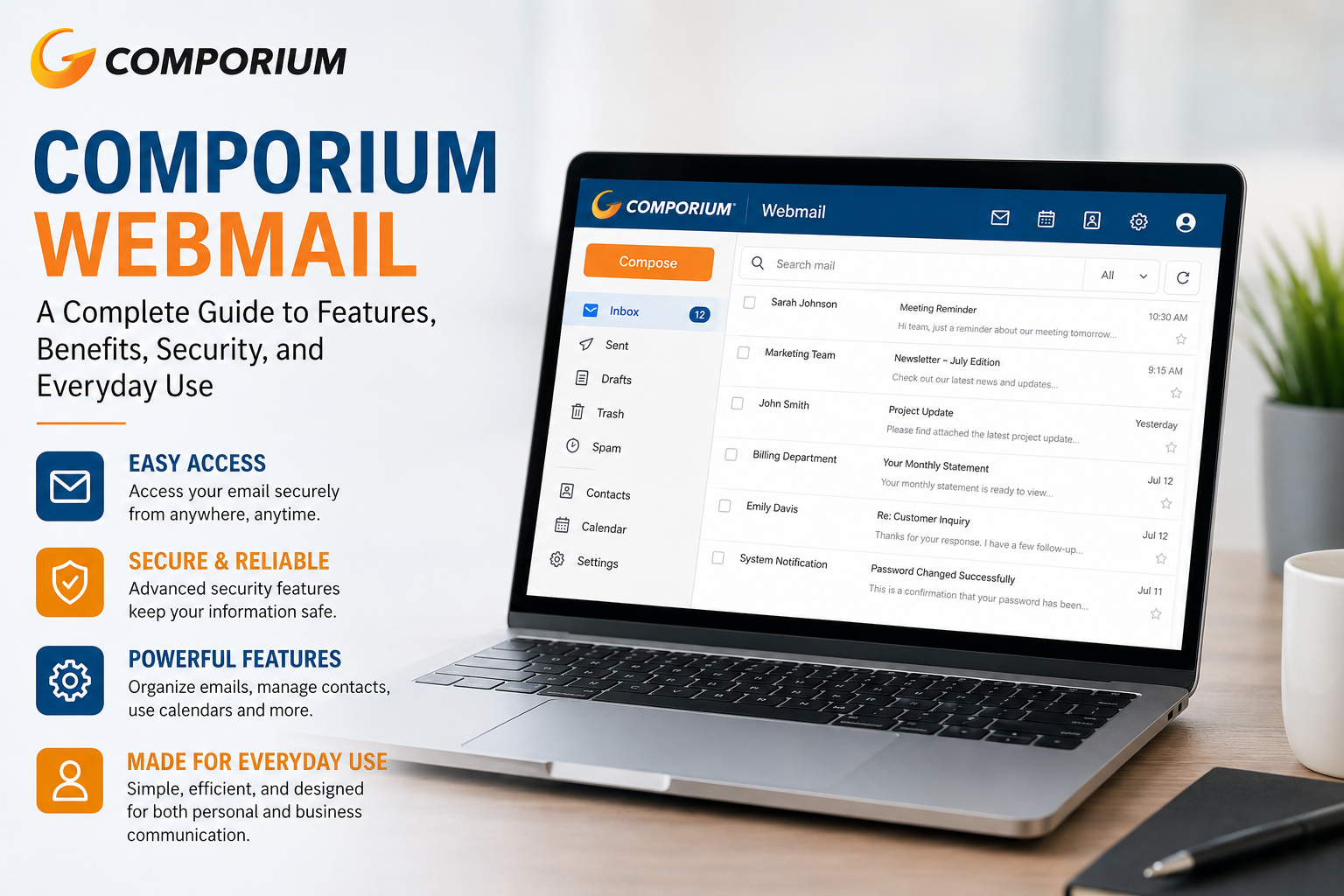
Comporium Webmail has become an essential communication platform for many residential and business customers who rely on dependable email services. In an era where digital communication supports nearly every aspect of daily life, having access to a stable email platform remains important for sending messages, organizing information, managing appointments, and staying connected with colleagues, family members, and clients.
Modern users expect more than simple email delivery. They look for intuitive interfaces, secure authentication, cloud accessibility, and reliable synchronization across multiple devices. These expectations have encouraged email providers to continuously improve their services while maintaining strong privacy and dependable performance.
This article explores how the platform works, its major features, security capabilities, productivity benefits, organization tools, common troubleshooting methods, and practical tips for maximizing efficiency.
Understanding Comporium Web mail
Email services have evolved significantly over the past two decades. Traditional desktop email programs required software installation and configuration before users could send or receive messages. Web-based email changed this experience by allowing users to access their inbox through an internet browser from virtually anywhere.
Comporium Webmail follows this browser-based approach, enabling subscribers to log in securely without depending on a particular operating system or device. Whether someone uses Windows, macOS, Linux, ChromeOS, or a mobile browser, the service provides convenient access through an internet connection.
The platform combines accessibility with simplicity, making it useful for individuals who want an easy-to-use communication system without complicated setup procedures.
Why Web-Based Email Remains Important
Although messaging applications have grown in popularity, email continues to serve as the primary communication method for businesses, educational institutions, healthcare organizations, government agencies, and online services.
Several factors explain why browser-based email remains valuable.
| Feature | Benefit |
|---|---|
| Universal compatibility | Works across nearly every internet-connected device |
| Cloud access | Messages remain available without relying on one computer |
| Professional communication | Suitable for formal conversations |
| Document sharing | Supports attachments of various file formats |
| Long-term storage | Important conversations remain searchable |
Unlike instant messaging, email provides structured communication that can be archived, searched, categorized, and referenced years later.
Core Features of Comporium Web mail
Every modern email service includes several essential tools designed to simplify communication and increase productivity.
One major advantage is browser accessibility. Users can sign in without installing specialized applications, making remote work significantly easier.
Another useful capability of Comporium Webmail is inbox organization. Messages can be grouped into folders to reduce clutter and improve search efficiency. Many users create categories for work, personal communication, bills, subscriptions, projects, and archived conversations, making Comporium Webmail easier to manage for everyday communication.
Attachment support enables documents, presentations, spreadsheets, images, and PDF files to be exchanged quickly. Instead of relying on physical storage devices, users can share information digitally within seconds.
Search functionality also improves productivity by locating older conversations using names, dates, keywords, or subjects.
Account Login Experience
Accessing an email account should be straightforward while maintaining strong security standards.
Most users begin by opening the official comporium webmail login page through their preferred browser. After entering their username and password, they gain access to the inbox, sent messages, drafts, contacts, and other available folders.
A secure login process protects sensitive information from unauthorized access while ensuring that only verified users can access stored messages.
Strong passwords remain one of the simplest yet most effective methods for protecting online accounts.
Interface Design and User Experience
A clean interface plays a major role in daily productivity.
Most users prefer dashboards that allow them to quickly locate folders, compose messages, search conversations, and manage contacts without unnecessary complexity.
A typical layout includes:
| Section | Primary Function |
| Inbox | Displays received messages |
| Sent Folder | Stores transmitted emails |
| Drafts | Saves unfinished messages |
| Trash | Contains deleted items |
| Spam Folder | Filters suspicious emails |
| Contacts | Organizes recipient information |
An intuitive interface reduces learning time while improving navigation for users of all experience levels.
Organizing Email Efficiently
Managing a growing inbox becomes easier when messages are categorized properly.
Folders provide long-term organization by separating communication according to projects, departments, family conversations, invoices, newsletters, or customer support interactions.
Search tools complement folder organization by locating messages using keywords or sender names.
Regular inbox maintenance also reduces unnecessary storage consumption while making important conversations easier to locate.
Security and Privacy Protection
Digital security remains one of the most important aspects of online communication.
Email accounts often contain financial records, confidential documents, invoices, personal conversations, and account recovery information.
Protecting these resources requires multiple security practices.
Strong passwords should combine uppercase letters, lowercase letters, numbers, and special characters. Password reuse across multiple services should be avoided because one compromised account can expose several others.
Users should also remain cautious when opening unexpected attachments or clicking unfamiliar links.
Spam filtering provides another layer of protection by separating suspicious messages from legitimate correspondence.
Managing Contacts
Frequent communication becomes much easier when contacts are organized efficiently.
Instead of typing email addresses repeatedly, users can save names, organizations, phone numbers, and additional notes inside a contact directory.
Well-maintained contact lists reduce typing errors while speeding up communication.
Business users often maintain categorized contact groups for departments, customers, vendors, suppliers, and internal teams.
Sending Professional Emails
Professional communication extends beyond correct grammar.
Effective emails begin with informative subject lines that summarize the message clearly.
Opening greetings establish a respectful tone before presenting information in concise paragraphs.
Attachments should always be referenced within the message so recipients understand their purpose.
Closing statements summarize required actions before ending with an appropriate signature.
Attachment Management
Attachments remain one of the most valuable features of email communication.
Users regularly exchange documents including reports, presentations, spreadsheets, contracts, invoices, manuals, photographs, and application forms.
Before attaching files, it is beneficial to verify that filenames are descriptive and file sizes remain manageable.
Compressed archives may be useful when multiple related files need to be shared simultaneously.
Productivity Benefits
Email platforms contribute significantly to workplace productivity.
Instead of relying on printed documents or in-person meetings for every discussion, teams can collaborate asynchronously regardless of location.
Archived conversations preserve project history while reducing misunderstandings.
The ability to search previous discussions also minimizes duplicated work because historical decisions remain accessible.
Mobile Accessibility
Modern communication increasingly depends on smartphones and tablets.
Browser compatibility allows users to access email while traveling, working remotely, attending conferences, or managing personal schedules away from desktop computers.
Responsive interfaces improve readability by adapting layouts to smaller screens without sacrificing usability.
Common Login Problems
Occasionally users encounter login issues.
Forgotten passwords represent one of the most common situations. Password recovery procedures typically restore account access after identity verification.
Incorrect usernames, browser cache issues, outdated saved credentials, or temporary internet connectivity problems may also prevent successful login.
Carefully reviewing entered credentials often resolves many access difficulties.
Storage Management
Growing inboxes eventually require storage management.
Deleting outdated newsletters, duplicate attachments, promotional messages, and unnecessary drafts frees valuable storage space.
Archiving important conversations preserves historical information while maintaining a cleaner primary inbox.
Routine maintenance prevents storage limitations from affecting future communication.
Avoiding Phishing Attacks
Cybercriminals frequently impersonate trusted organizations.
Phishing emails often encourage recipients to reveal passwords, financial information, or verification codes.
Several warning signs deserve attention.
Unexpected urgency, spelling mistakes, unfamiliar sender addresses, suspicious links, and requests for confidential information frequently indicate fraudulent communication.
Verifying requests through official channels remains the safest approach.
Business Applications
Businesses rely on dependable email systems for numerous daily activities.
Customer service representatives respond to inquiries.
Accounting departments exchange invoices.
Human resources communicate with applicants.
Management distributes announcements.
Sales teams coordinate proposals and negotiations.
Reliable email infrastructure therefore contributes directly to organizational efficiency.
Personal Communication Benefits
Beyond business use, webmail supports everyday communication among families, students, community organizations, and hobby groups.
People use email for travel confirmations, educational updates, appointment reminders, subscription management, online purchases, banking notifications, and personal conversations.
Centralizing these interactions simplifies digital organization.
Future Developments
Comporium Webmail continues evolving through improvements in artificial intelligence, spam detection, encryption, accessibility, and cloud integration, helping users enjoy a more secure and efficient email experience.”.
Future innovations may further automate inbox organization, improve search capabilities, strengthen threat detection, and simplify cross-device synchronization.
Although communication methods continue expanding, email remains a dependable foundation for formal digital correspondence.
Best Practices for Daily Use
Developing consistent habits improves both security and productivity.
Regular password updates strengthen account protection.
Inbox organization saves time.
Reviewing suspicious messages carefully reduces security risks.
Deleting unnecessary emails conserves storage space.
Backing up important information ensures valuable communication remains protected.
These practices collectively create a more efficient and secure email experience.
Conclusion
Comporium Webmail continues to provide users with a practical browser-based communication platform suitable for both personal and professional needs. By combining convenient access, organized inbox management, attachment support, dependable security practices, and cross-device compatibility, the service supports modern communication without unnecessary complexity.
As digital interactions continue expanding, maintaining good email habits becomes increasingly important. Organizing messages, protecting account credentials, remaining alert to phishing attempts, and regularly managing storage all contribute to a smoother experience. Whether used for everyday conversations, business correspondence, educational purposes, or document sharing, a well-managed email account remains an essential tool in today’s connected world