
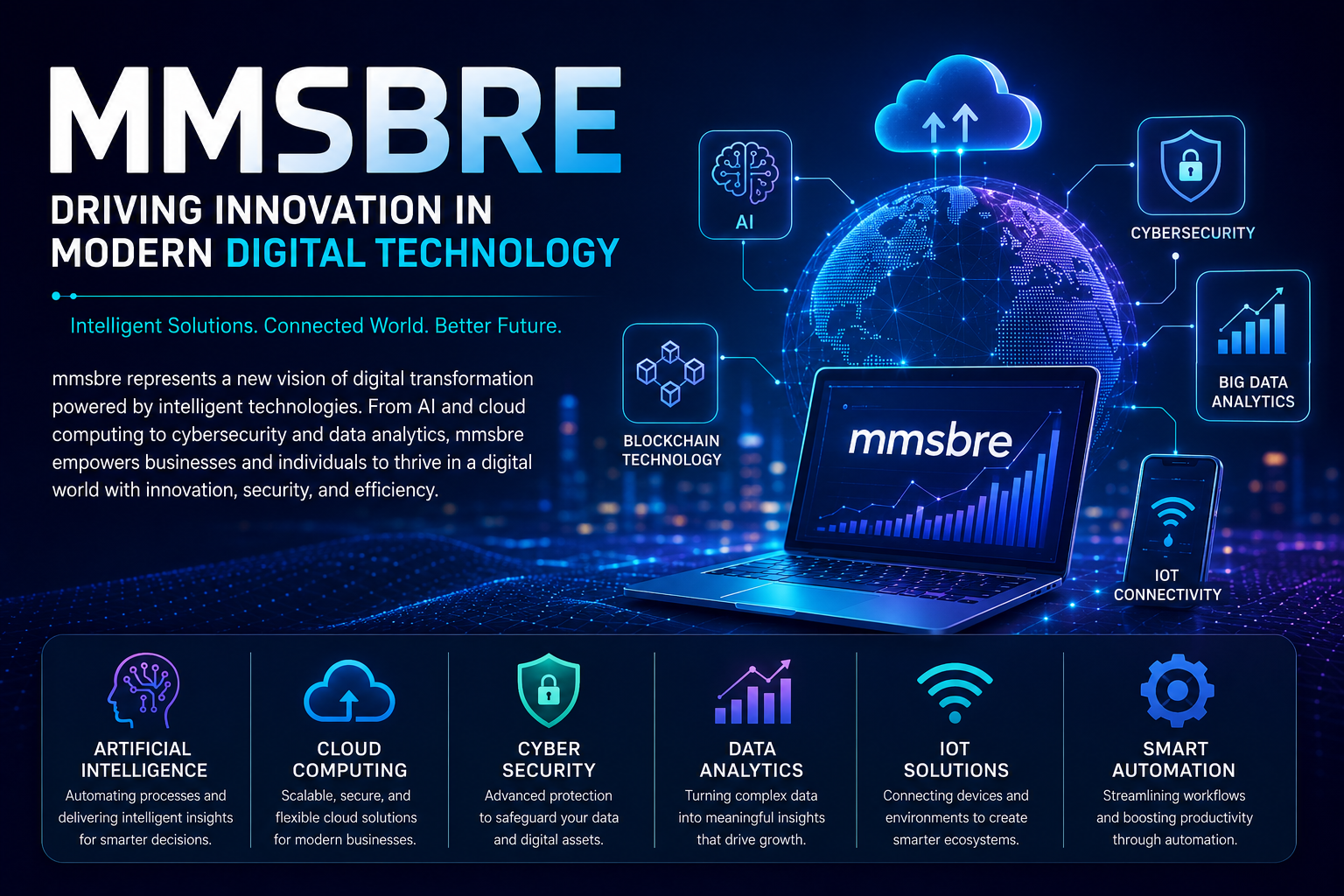
mmsbre has emerged as a term associated with the rapid evolution of digital technology and intelligent innovation. As businesses, educational institutions, and technology professionals embrace smarter digital ecosystems, concepts represented by mmsbre highlight the importance of integrating advanced technologies into everyday operations. From artificial intelligence and cloud computing to cybersecurity and big data analytics, modern technological solutions continue transforming industries while creating new opportunities for growth and efficiency.
Digital transformation is no longer limited to large enterprises. Small businesses, startups, educational organizations, and government agencies increasingly adopt intelligent technologies to automate processes, improve customer experiences, and strengthen decision-making. Within this environment, mmsbre symbolizes a technology-first approach that encourages innovation, adaptability, and continuous improvement. Organizations that successfully embrace these digital capabilities position themselves for long-term competitiveness in an increasingly connected world.
Understanding mmsbre in the Digital Era
The digital era has fundamentally changed how information is created, processed, and shared. Modern organizations generate enormous volumes of data every second through websites, mobile applications, connected devices, and cloud platforms. Managing this information effectively requires intelligent systems capable of transforming raw data into valuable insights.
The technological vision represented by mmsbre reflects this shift toward data-driven operations. Rather than relying on traditional manual processes, organizations now use automation, analytics, and artificial intelligence to improve efficiency. These technologies reduce operational complexity while enabling faster and more accurate decision-making across industries.
Businesses also benefit from greater flexibility because digital platforms support remote collaboration, secure communication, and scalable infrastructure. As technology continues advancing, intelligent digital ecosystems become increasingly important for organizations seeking sustainable growth.
The Evolution of mmsbre Technology
Technology has evolved dramatically over the past two decades. Early digital systems focused primarily on storing information electronically, while today’s platforms emphasize automation, predictive analytics, and intelligent decision support.
Cloud computing has replaced many traditional data centers by offering scalable resources that organizations can access whenever needed. Artificial intelligence has introduced automated learning capabilities that continuously improve system performance without constant human intervention.
Machine learning algorithms analyze customer behavior, financial trends, operational performance, and business risks with exceptional speed. These innovations enable organizations to identify opportunities and challenges before they become significant issues.
| Technology Generation | Primary Innovation | Business Benefit |
|---|---|---|
| Traditional Computing | Local software | Basic automation |
| Internet Era | Online connectivity | Global communication |
| Cloud Computing | Remote infrastructure | Scalability |
| Artificial Intelligence | Intelligent automation | Faster decisions |
| Smart Digital Systems | Predictive analytics | Business optimization |
mmsbre and Artificial Intelligence
Artificial intelligence has become one of the most influential technologies of the modern era. Intelligent systems learn from historical data, recognize complex patterns, and provide recommendations that improve organizational performance.
Businesses increasingly rely on AI-powered applications for customer support, fraud detection, recommendation engines, predictive maintenance, and workflow automation. Virtual assistants respond to customer inquiries instantly while machine learning models continuously improve their accuracy through ongoing analysis.
Natural language processing enables computers to understand and generate human language, making digital interactions more intuitive. Image recognition systems identify objects, documents, and visual patterns with remarkable precision, reducing manual effort across healthcare, manufacturing, finance, and retail sectors.
The integration of artificial intelligence into modern digital ecosystems demonstrates how intelligent automation enhances productivity while supporting innovation.
mmsbre and Cloud Computing
Cloud computing has transformed the way organizations manage digital resources. Instead of maintaining expensive physical infrastructure, businesses increasingly rely on cloud platforms to store data, host applications, and support collaboration.
Cloud services offer flexibility because computing resources can expand or contract according to demand. This scalability enables organizations to optimize costs while maintaining reliable performance during periods of increased activity.
Remote work has also accelerated cloud adoption. Employees access secure business applications from virtually any location while maintaining productivity and collaboration through cloud-based communication platforms.
Cloud technology supports business continuity by providing automatic backups, disaster recovery capabilities, and enhanced security features that protect valuable organizational information.
mmsbre and Cybersecurity
As organizations become increasingly connected, cybersecurity remains one of the most critical aspects of digital transformation. Every connected system introduces potential security risks that require proactive protection.
Modern cybersecurity strategies combine encryption, identity verification, intrusion detection, and automated monitoring to safeguard digital assets. Artificial intelligence further strengthens cybersecurity by identifying unusual activity before significant damage occurs.
Employee education also plays a crucial role in protecting organizational information. Strong passwords, multi-factor authentication, and awareness of phishing attacks significantly reduce security vulnerabilities.
Organizations that invest in comprehensive cybersecurity frameworks build greater trust with customers while protecting sensitive financial, operational, and personal information.
| Cybersecurity Component | Purpose | Organizational Advantage |
| Encryption | Protect sensitive data | Secure communication |
| Multi-Factor Authentication | Verify user identity | Stronger access control |
| Threat Monitoring | Detect cyber risks | Early response |
| Automated Backups | Recover information | Business continuity |
| AI Security Analytics | Predict attacks | Improved resilience |
mmsbre and Big Data Analytics
Modern organizations generate enormous amounts of structured and unstructured data every day. Big data analytics enables businesses to transform this information into meaningful insights that support strategic planning.
Retail companies analyze customer purchasing behavior to improve inventory management and marketing strategies. Financial institutions evaluate transaction patterns to identify fraudulent activities. Healthcare providers study patient information to improve treatment outcomes and resource allocation.
Advanced analytics platforms combine historical records with real-time information, allowing organizations to respond quickly to changing conditions. Interactive dashboards simplify complex datasets, making valuable insights accessible to both technical experts and business leaders.
The ability to extract meaningful intelligence from large datasets has become a major competitive advantage across nearly every industry.
mmsbre and Internet of Things
The Internet of Things has connected billions of devices worldwide, creating intelligent digital environments capable of collecting and sharing information automatically. Smart sensors continuously monitor equipment performance, environmental conditions, transportation systems, and industrial operations.
Manufacturing companies use connected devices to predict maintenance requirements before machinery fails. Smart buildings optimize energy consumption by adjusting lighting and climate control according to occupancy patterns. Agricultural operations monitor soil moisture, weather conditions, and crop health to improve productivity.
IoT technologies integrated with cloud computing and artificial intelligence create highly responsive systems that improve efficiency while reducing operational costs.
mmsbre in Business Innovation
Innovation has become essential for organizations seeking long-term success in competitive markets. Digital technologies enable businesses to redesign processes, improve customer engagement, and develop entirely new products and services.
Automation reduces repetitive administrative tasks, allowing employees to focus on higher-value activities requiring creativity and strategic thinking. Digital collaboration tools improve communication across departments while supporting hybrid and remote work environments.
Customer relationship management systems collect valuable information that helps organizations personalize experiences, strengthen customer loyalty, and improve overall satisfaction.
As digital transformation accelerates, organizations embracing innovative technologies become more agile, efficient, and competitive within rapidly changing markets.
mmsbre and Blockchain Technology
Blockchain technology has become one of the most transformative innovations in the digital economy. As organizations seek greater transparency, security, and efficiency, blockchain provides a decentralized framework for recording and verifying transactions. Within the broader technological landscape, mmsbre reflects the adoption of secure digital solutions that enhance trust across industries.
Unlike traditional databases that rely on centralized management, blockchain distributes information across multiple systems, making unauthorized modifications significantly more difficult. Financial institutions use blockchain for secure transactions, while supply chain organizations track products from manufacturing to delivery. Healthcare providers also explore blockchain for protecting patient records and ensuring data integrity. As blockchain continues to evolve, its integration with intelligent digital platforms will create new opportunities for innovation and operational excellence.
mmsbre and Digital Marketing Technologies
Digital marketing has evolved far beyond traditional online advertising. Modern businesses rely on intelligent platforms that analyze customer behavior, automate campaigns, and personalize communication. Technologies associated with mmsbre help organizations understand audience preferences and deliver relevant content through multiple digital channels.
Artificial intelligence supports marketing by predicting customer interests, recommending products, and optimizing advertising performance. Search engine optimization, social media analytics, email automation, and content management systems work together to strengthen online visibility and customer engagement. These technologies enable businesses to make informed decisions based on measurable data rather than assumptions.
Organizations also benefit from real-time reporting that highlights campaign performance, customer interactions, and conversion trends. This continuous flow of information supports long-term marketing strategies while improving return on investment.
mmsbre in Education Technology
Education has undergone remarkable digital transformation through online learning platforms, virtual classrooms, cloud-based collaboration, and interactive educational resources. The technological concepts represented by mmsbre contribute to more flexible and accessible learning environments for students worldwide.
Learning management systems allow educators to distribute course materials, monitor student progress, and conduct assessments through secure online platforms. Artificial intelligence assists with personalized learning by adapting educational content according to individual performance and learning styles.
Virtual laboratories, augmented reality applications, and simulation technologies provide students with practical experiences that complement traditional classroom instruction. These innovations improve engagement while expanding educational opportunities regardless of geographic location.
| Educational Technology | Primary Benefit | Learning Outcome |
|---|---|---|
| Learning Management Systems | Online education | Flexible learning |
| Artificial Intelligence | Personalized instruction | Improved performance |
| Virtual Reality | Interactive experiences | Better engagement |
| Cloud Collaboration | Resource sharing | Teamwork enhancement |
| Digital Assessments | Progress monitoring | Accurate evaluation |
mmsbre and Healthcare Innovation
Healthcare organizations increasingly depend on advanced digital technologies to improve patient care, operational efficiency, and medical research. Intelligent systems help hospitals manage electronic health records, schedule appointments, monitor medical equipment, and support clinical decision-making.
Artificial intelligence assists healthcare professionals by analyzing medical images, identifying disease patterns, and recommending treatment options based on historical data. Wearable devices continuously monitor patient health while transmitting information to healthcare providers through secure digital platforms.
Telemedicine has further expanded access to healthcare services by enabling virtual consultations between patients and medical professionals. These digital innovations reduce travel requirements while improving healthcare accessibility for rural and underserved communities.
mmsbre and Financial Technology
The financial sector has rapidly adopted digital technologies to improve security, efficiency, and customer experiences. Online banking, mobile payment platforms, digital wallets, and automated investment tools have transformed how individuals and businesses manage financial activities.
Modern financial institutions utilize artificial intelligence to detect fraudulent transactions, evaluate credit risks, and automate customer support. Cloud computing provides secure infrastructure capable of processing millions of transactions while maintaining reliability and compliance with regulatory standards.
Advanced analytics also help financial organizations understand customer behavior, improve service delivery, and develop innovative financial products tailored to changing market demands.
mmsbre and Smart Business Operations
Business operations continue evolving through intelligent automation, cloud collaboration, and predictive analytics. Organizations increasingly integrate digital technologies into manufacturing, logistics, customer service, and supply chain management to improve efficiency.
Robotic process automation eliminates repetitive administrative tasks, reducing errors while increasing productivity. Predictive analytics forecasts inventory requirements, customer demand, and equipment maintenance schedules, enabling businesses to allocate resources more effectively.
Digital collaboration platforms strengthen communication among employees working across multiple locations. These technologies support faster decision-making while encouraging innovation throughout the organization.
| Business Technology | Operational Benefit | Organizational Result |
| Robotic Automation | Reduced manual work | Higher productivity |
| Predictive Analytics | Future forecasting | Better planning |
| Cloud Collaboration | Remote teamwork | Improved communication |
| Business Intelligence | Data visualization | Smarter decisions |
| Workflow Automation | Process efficiency | Lower operating costs |
Future Trends for mmsbre
The future of digital technology promises even greater integration among artificial intelligence, cloud computing, blockchain, quantum computing, and intelligent automation. Organizations adopting innovative digital strategies will benefit from faster processing capabilities, enhanced cybersecurity, and increasingly accurate predictive models.
Edge computing will process information closer to connected devices, reducing response times and improving system performance. Autonomous technologies will continue expanding across transportation, manufacturing, agriculture, and logistics.
Generative artificial intelligence will further transform content creation, software development, customer service, and research activities. Businesses will increasingly combine multiple intelligent technologies to create highly adaptive digital ecosystems capable of responding automatically to changing business conditions.
Sustainability will also influence future technological development as organizations invest in energy-efficient data centers, environmentally responsible computing infrastructure, and digital solutions that reduce resource consumption.
Challenges Associated with mmsbre
Despite significant technological progress, organizations continue facing several challenges during digital transformation. Cybersecurity remains a major concern because increasingly connected systems create additional opportunities for cyber threats. Continuous monitoring, employee training, and advanced security frameworks are essential for maintaining digital resilience.
Data privacy regulations require organizations to manage personal information responsibly while maintaining transparency regarding data collection and usage practices. Compliance with international standards has become increasingly important as businesses operate across global markets.
Another challenge involves workforce development. Employees must continually update their digital skills to remain effective within rapidly changing technological environments. Investment in education and professional training ensures organizations maximize the value of emerging technologies.
Legacy systems also present integration challenges because older infrastructure may not fully support modern cloud-based platforms and intelligent automation tools. Careful planning and phased modernization strategies help organizations overcome these limitations successfully.
Conclusion
mmsbre represents the ongoing advancement of intelligent digital technologies that continue transforming industries worldwide. By combining artificial intelligence, cloud computing, cybersecurity, blockchain, big data analytics, and Internet of Things technologies, organizations create more efficient, secure, and innovative digital environments.
Businesses, educational institutions, healthcare providers, financial organizations, and government agencies increasingly rely on these technologies to improve decision-making, strengthen operational performance, and deliver better services. As digital transformation continues accelerating, intelligent technological ecosystems will become even more important for maintaining competitiveness and supporting sustainable growth.
Organizations embracing innovation today will be better prepared for tomorrow’s technological landscape, where automation, connectivity, and data-driven intelligence define success across every industry.
Frequently Asked Questions About mm-sbre
What is mm-sbre?
mmsbre is a technology-focused concept representing innovation in digital transformation through artificial intelligence, cloud computing, cybersecurity, big data, and other modern technologies.
Why is mm-sbre important?
It highlights the growing role of intelligent digital technologies that improve efficiency, security, collaboration, and decision-making across businesses and organizations.
Which industries benefit from mm-sbre?
Healthcare, education, finance, manufacturing, retail, logistics, government, and technology companies all benefit from digital solutions associated with mmsbre.
How does artificial intelligence support mm-sbre?
Artificial intelligence automates repetitive tasks, analyzes large datasets, improves customer experiences, predicts future trends, and enhances operational efficiency.
What is the future of mm-sbre?
The future includes greater adoption of AI, blockchain, quantum computing, edge computing, cloud platforms, intelligent automation, and sustainable digital infrastructure, creating smarter and more connected organizations worldwide.