
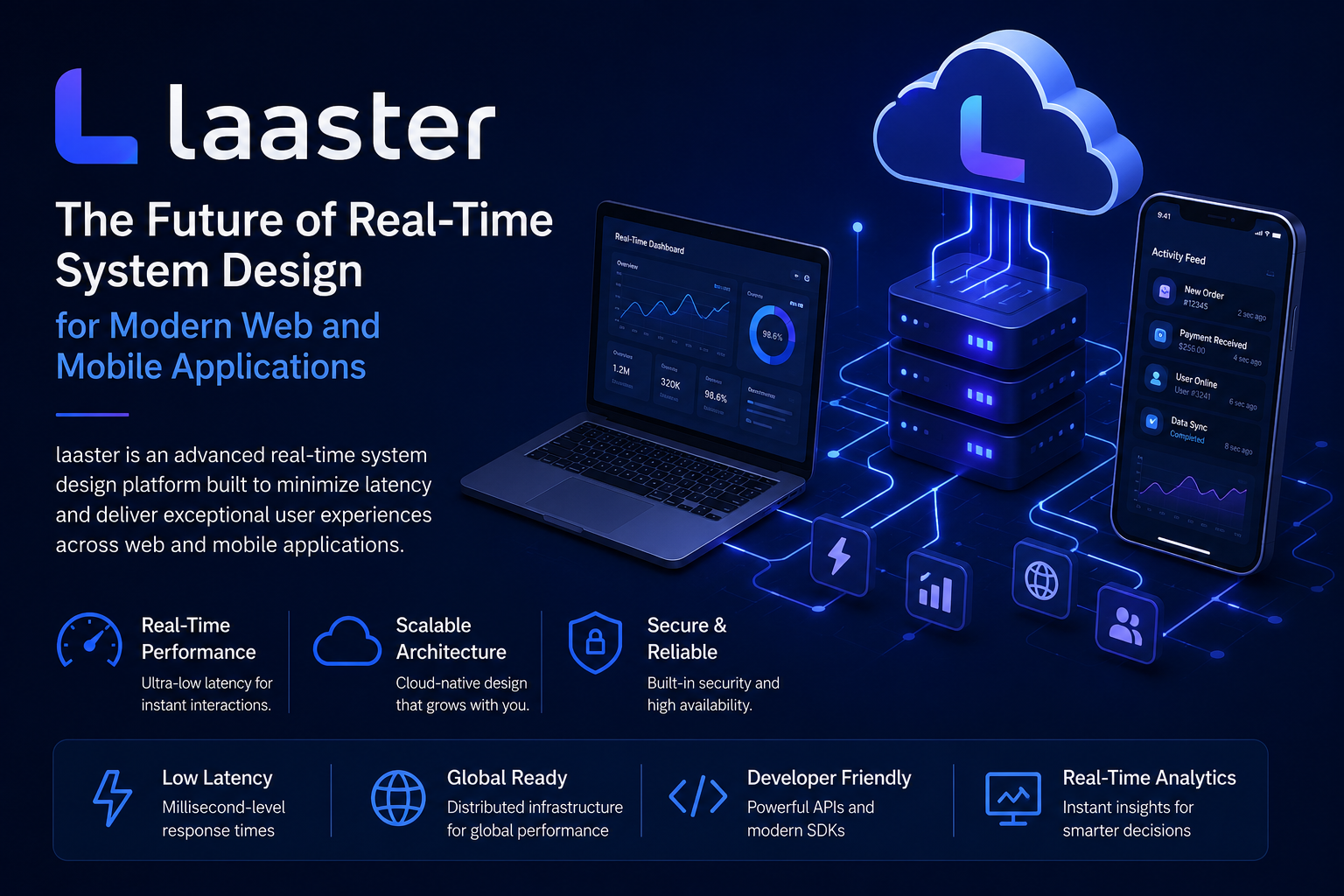
The demand for high-performance digital applications has grown rapidly as businesses and consumers expect instant responses from websites and mobile apps. In this evolving technology landscape, laaster has emerged as an advanced real-time system design platform built specifically to minimize latency and enhance overall user experience. By combining scalable architecture, intelligent data processing, cloud-native infrastructure, and modern development practices, laaster enables organizations to build applications that remain responsive even under heavy workloads. As digital services continue expanding across industries, platforms designed around real-time performance have become essential for maintaining competitiveness and customer satisfaction.
Modern software development extends far beyond creating functional applications. Users now expect seamless interactions, immediate data synchronization, secure communication, and uninterrupted availability across multiple devices. Businesses therefore require technologies capable of supporting millions of simultaneous requests without compromising speed or reliability. This is where advanced real-time platforms demonstrate significant value by delivering consistent performance while remaining flexible enough to adapt to future technological innovations.
| Feature | Traditional System Design | laaster Platform |
|---|---|---|
| Response Time | Moderate | Real-Time Performance |
| Scalability | Limited | Highly Scalable |
| Infrastructure | Conventional Servers | Cloud-Native Architecture |
| User Experience | Standard | Optimized and Responsive |
| Data Processing | Batch-Based | Instant Processing |
Understanding laaster Architecture
The foundation of laaster lies in its ability to process information with minimal delay while maintaining stability across distributed environments. Rather than relying on centralized systems that may create bottlenecks, modern architecture distributes workloads efficiently across multiple computing resources. This approach allows applications to remain responsive even when user activity increases dramatically.
Scalable architecture is one of the defining characteristics of next-generation application platforms. Instead of replacing existing infrastructure whenever demand grows, organizations can expand computing resources dynamically. This flexibility reduces operational costs while improving service availability and overall reliability.
Microservices architecture further enhances performance by separating complex applications into independent services. Each service performs a dedicated function while communicating securely with others through application programming interfaces. This modular design simplifies maintenance, accelerates software updates, and improves fault tolerance throughout the application lifecycle.
How laaster Reduces Latency
Reducing latency has become a primary objective for organizations delivering digital services. Every millisecond saved contributes to improved customer satisfaction, higher engagement, and better business outcomes. laaster achieves low-latency performance through intelligent workload distribution, optimized communication protocols, and efficient resource allocation.
Edge computing plays an important role by moving data processing closer to users rather than relying entirely on centralized cloud servers. This minimizes transmission delays and supports real-time interactions within applications requiring immediate responsiveness. Industries such as financial technology, healthcare, gaming, education, and e-commerce particularly benefit from these improvements because they rely heavily on fast information exchange.
Caching mechanisms further accelerate performance by storing frequently accessed information closer to application users. Instead of retrieving identical information repeatedly from primary databases, intelligent caching delivers content almost instantly, reducing server load while improving application responsiveness.
Core Technologies Behind laaster
The capabilities of laaster are supported by several advanced technologies working together as a unified ecosystem. Cloud computing provides flexible infrastructure capable of scaling according to changing workloads. Artificial intelligence assists with predictive optimization, helping systems allocate resources efficiently before performance bottlenecks occur.
High-performance databases designed for real-time workloads enable rapid storage and retrieval of information without sacrificing consistency or reliability. Combined with distributed networking technologies, these databases support applications that require immediate synchronization across multiple geographic regions.
| Technology | Primary Purpose | Organizational Benefit |
| Cloud Computing | Elastic Infrastructure | Flexible Scaling |
| Edge Computing | Local Processing | Lower Latency |
| Artificial Intelligence | Predictive Optimization | Better Efficiency |
| Containerization | Consistent Deployment | Faster Development |
| Distributed Databases | Real-Time Data Access | Improved Reliability |
laaster for Modern Web Development
Web applications have evolved into sophisticated digital platforms supporting commerce, communication, education, entertainment, and enterprise collaboration. Performance expectations continue rising as users demand near-instant page loading, responsive interfaces, and uninterrupted functionality. laaster supports these requirements through an architecture designed specifically for modern web technologies.
Responsive web applications depend on efficient communication between client interfaces and backend services. Real-time synchronization ensures users receive updated information immediately without repeatedly refreshing pages. This creates smoother experiences while reducing unnecessary network traffic.
Developers also benefit from modular design principles that simplify maintenance and future expansion. Independent application components can be updated individually without interrupting the entire platform, improving reliability while accelerating software delivery cycles.
laaster for Mobile Application Development
Mobile devices have become the primary method through which billions of people access digital services. Consequently, application developers must optimize performance for varying network conditions, device capabilities, and operating systems. laaster provides the technological foundation necessary to deliver consistent experiences across smartphones and tablets.
Real-time communication enables messaging platforms, collaborative applications, navigation systems, and live streaming services to function efficiently with minimal delays. Optimized synchronization reduces battery consumption while ensuring users always interact with the most current information available.
Cross-platform development frameworks further enhance productivity by allowing developers to maintain shared codebases while delivering native-like experiences across multiple operating systems. This reduces development costs and accelerates software releases without sacrificing application quality.
Security and Reliability in laaster
Security remains an essential component of every digital platform. Modern applications process sensitive information that requires comprehensive protection throughout storage, transmission, and user interactions. laaster incorporates advanced security principles into its architecture to safeguard digital assets while maintaining uninterrupted service availability.
Encryption protects confidential information during communication, while multi-factor authentication strengthens identity verification. Automated monitoring systems continuously analyze infrastructure activity, identifying potential security threats before they impact application performance.
Reliable disaster recovery strategies further enhance operational resilience. Distributed infrastructure, automated backups, and intelligent failover mechanisms help organizations maintain service continuity even when unexpected technical issues occur. These capabilities strengthen user confidence while supporting long-term business stability.
laaster and Cloud-Native Infrastructure
Cloud-native architecture has transformed the way modern applications are developed, deployed, and maintained. Rather than depending on fixed infrastructure, organizations now build systems that automatically adapt to changing workloads. laaster embraces this approach by utilizing distributed cloud resources, intelligent orchestration, and automated scaling to ensure applications remain responsive regardless of user demand.
Cloud-native development encourages continuous integration and continuous deployment, allowing development teams to introduce new features with minimal disruption. Automated testing and deployment pipelines reduce manual effort while improving software quality. This streamlined workflow shortens release cycles, enabling businesses to respond quickly to market changes and customer feedback.
| Cloud Capability | Function | Business Advantage |
|---|---|---|
| Auto Scaling | Expands resources automatically | Handles traffic spikes |
| Load Balancing | Distributes requests | Stable performance |
| Continuous Deployment | Faster software releases | Improved productivity |
| Fault Recovery | Automatic service restoration | Higher availability |
| Resource Monitoring | Performance optimization | Efficient infrastructure |
Real-Time Data Processing with laaster
Modern applications increasingly rely on continuous streams of information generated by users, connected devices, payment systems, and enterprise software. Processing this information immediately allows organizations to deliver faster decisions and more personalized digital experiences. laaster is designed to support these real-time workloads without compromising stability or scalability.
Event-driven architecture further enhances responsiveness by allowing independent services to react automatically whenever significant activities occur. Instead of repeatedly checking for updates, applications receive notifications instantly, reducing unnecessary processing while improving responsiveness.
Advanced messaging systems ensure reliable communication between services even during periods of heavy demand. This architecture maintains consistent performance while supporting millions of simultaneous transactions across distributed environments.
laaster and Application Scalability
Scalability has become one of the defining characteristics of successful software platforms. As organizations expand, applications must accommodate increasing numbers of users without sacrificing performance. laaster addresses this challenge through flexible infrastructure capable of growing dynamically according to workload requirements.
Horizontal scaling distributes workloads across multiple servers, reducing pressure on individual resources while improving fault tolerance. Vertical scaling complements this approach by increasing computing capacity whenever additional processing power becomes necessary. Combining both strategies enables organizations to optimize operational efficiency while controlling infrastructure costs.
Elastic resource management also contributes to sustainability by allocating computing resources only when required. During periods of lower activity, unused resources can be released automatically, reducing operational expenses while maintaining readiness for future demand.
Artificial Intelligence Integration in laaster
Artificial intelligence has become an essential component of next-generation application development. Intelligent algorithms enhance operational efficiency by automating repetitive tasks, predicting resource requirements, and identifying patterns within large datasets. Within laaster, AI contributes to system optimization without increasing architectural complexity.
Machine learning models also improve application functionality by delivering personalized recommendations, optimizing search capabilities, and enhancing fraud detection. As algorithms continue learning from new information, overall system accuracy improves over time.
Natural language processing supports conversational interfaces, intelligent assistants, and automated customer support, enabling organizations to deliver efficient services while reducing operational overhead.
| Artificial Intelligence Feature | Purpose | Practical Benefit |
| Predictive Analytics | Forecast demand | Better resource allocation |
| Machine Learning | Continuous improvement | Higher accuracy |
| Natural Language Processing | Human-computer interaction | Improved communication |
| Intelligent Automation | Process optimization | Greater efficiency |
| Pattern Recognition | Detect anomalies | Stronger security |
Security Framework within laaster
The increasing volume of digital transactions requires comprehensive protection strategies that extend beyond traditional cybersecurity measures. laaster incorporates multiple layers of security designed to protect applications, infrastructure, and user information throughout every stage of operation.
Zero Trust architecture has become increasingly important because it assumes that every connection must be verified regardless of its origin. Identity verification, encrypted communications, and continuous authentication work together to reduce security risks while maintaining seamless user experiences.
Compliance with international security standards further supports organizational credibility. Secure software development practices, vulnerability assessments, and regular infrastructure audits help maintain long-term protection while satisfying regulatory requirements.
User Experience Optimization through laaster
Excellent technology depends not only on powerful infrastructure but also on delivering intuitive and enjoyable user experiences. Modern consumers expect applications to respond immediately while providing consistent functionality across desktops, smartphones, tablets, and wearable devices. laaster prioritizes user-centered design principles alongside technical performance.
Responsive interfaces automatically adapt to different screen sizes, ensuring visual consistency regardless of device type. Optimized navigation reduces complexity while helping users complete tasks efficiently. Fast-loading content minimizes waiting times, improving overall engagement and reducing abandonment rates.
Accessibility also remains a central consideration. Applications designed according to recognized accessibility standards enable broader audiences to interact comfortably with digital services. Inclusive design strengthens customer satisfaction while expanding potential market reach.
Future Innovation Supported by laas ter
Technology continues evolving through advances in distributed computing, intelligent automation, immersive digital experiences, and sustainable infrastructure. laaster is positioned to support these developments by providing an adaptable foundation capable of integrating future technologies without requiring extensive architectural redesign.
Emerging innovations such as quantum computing research, edge intelligence, autonomous systems, and decentralized networking may significantly influence software development over the coming decade. Organizations that adopt flexible digital platforms today will be better prepared to incorporate these technologies as they mature.
| Emerging Trend | Expected Influence | Organizational Value |
| Edge Intelligence | Faster decision-making | Improved responsiveness |
| Autonomous Systems | Reduced manual processes | Operational efficiency |
| Sustainable Computing | Lower environmental impact | Responsible innovation |
| Advanced Analytics | Better forecasting | Strategic planning |
| Distributed Networking | Improved resilience | Reliable connectivity |
Enterprise Adoption of laas ter
Organizations across industries are investing in technologies that improve responsiveness, scalability, and operational efficiency. As digital services become increasingly important, businesses require platforms capable of supporting continuous innovation without sacrificing reliability. laaster provides a modern foundation that enables enterprises to develop applications capable of handling real-time interactions while maintaining consistent performance across global environments.
Financial institutions benefit from low-latency architectures that support secure payment processing and fraud detection. Healthcare organizations rely on responsive systems to manage electronic health records, telemedicine platforms, and real-time patient monitoring. Retail businesses improve customer engagement through personalized shopping experiences, inventory synchronization, and intelligent recommendation engines. Educational institutions also leverage modern digital infrastructure to deliver interactive learning environments and collaborative online classrooms.
Manufacturing companies integrate connected devices and production monitoring systems to improve operational visibility and reduce downtime. Logistics providers use real-time tracking and route optimization to enhance delivery accuracy. These examples illustrate how advanced application platforms support digital transformation across diverse industries while meeting increasingly demanding performance expectations.
Performance Optimization in laas ter
High-performance applications depend on continuous optimization rather than one-time configuration. Every component within a distributed system contributes to the overall user experience, making efficient resource management essential for maintaining responsiveness. laaster incorporates intelligent optimization techniques that improve processing speed while minimizing unnecessary resource consumption.
Database indexing, intelligent caching, asynchronous processing, and workload balancing all contribute to improved application performance. These technologies reduce waiting times for users while maximizing hardware utilization. Automated monitoring systems continuously evaluate system health and recommend improvements before performance degradation affects production environments.
| Performance Area | Optimization Method | Result |
|---|---|---|
| Database Access | Indexing and Query Optimization | Faster Retrieval |
| Content Delivery | Distributed Caching | Reduced Latency |
| Network Communication | Efficient API Design | Improved Responsiveness |
| Infrastructure | Automatic Scaling | Consistent Performance |
| Monitoring | Real-Time Analytics | Proactive Maintenance |
The Development Workflow with laas ter
Modern software engineering emphasizes collaboration, automation, and continuous improvement throughout the development lifecycle. laaster supports these objectives by integrating seamlessly with contemporary development practices that encourage rapid innovation while maintaining software quality.
Development teams benefit from automated testing pipelines that identify potential issues before deployment. Version control systems simplify collaboration between engineers working on different application components, while containerized environments ensure consistent execution across development, testing, and production.
This streamlined workflow reduces operational complexity and encourages frequent innovation without introducing unnecessary risk into production environments.
The Future Outlook for laas ter
The technology industry continues advancing through innovations in artificial intelligence, cloud computing, distributed systems, and intelligent automation. As digital transformation accelerates, organizations will increasingly prioritize platforms capable of supporting real-time communication, scalable infrastructure, and exceptional user experiences. laaster aligns with these evolving requirements by providing a flexible architecture designed for long-term adaptability.
Global expansion of high-speed internet connectivity and edge computing infrastructure will further strengthen the demand for responsive digital applications. Businesses prepared to adopt modern architectural principles will be better positioned to compete within increasingly connected markets.
Innovation also depends on continuous learning and technological evolution. Organizations that invest in adaptable digital ecosystems today create opportunities for future growth while reducing the challenges associated with large-scale infrastructure modernization.
Conclusion
The rapid growth of digital services has created unprecedented demand for platforms capable of delivering fast, reliable, and scalable application experiences. laaster addresses these requirements by combining real-time system design, cloud-native architecture, intelligent automation, distributed computing, and strong security practices into a unified technology platform.
Its emphasis on minimizing latency, improving scalability, and enhancing user experience makes it well suited for modern web and mobile application development across numerous industries.
The continued evolution of application development highlights the importance of investing in technologies capable of adapting to future challenges. Modern organizations require solutions that balance innovation with stability, ensuring sustainable growth while delivering exceptional experiences to users. Through its comprehensive approach to real-time architecture and scalable system design, laaster represents a forward-looking framework for building the next generation of web and mobile applications.
| Key Technology Area | Business Impact |
| Real-Time Processing | Faster application responses |
| Cloud-Native Architecture | Flexible infrastructure growth |
| Artificial Intelligence | Intelligent automation |
| Distributed Computing | Improved reliability |
| Security Framework | Strong data protection |
| Performance Optimization | Better user satisfaction |
| Continuous Innovation | Long-term business value |
The future of application development belongs to platforms that deliver speed, resilience, scalability, and seamless user experiences. Organizations that embrace these principles will be better equipped to meet evolving market expectations, support digital transformation, and create lasting value in an increasingly competitive technology landscape.