
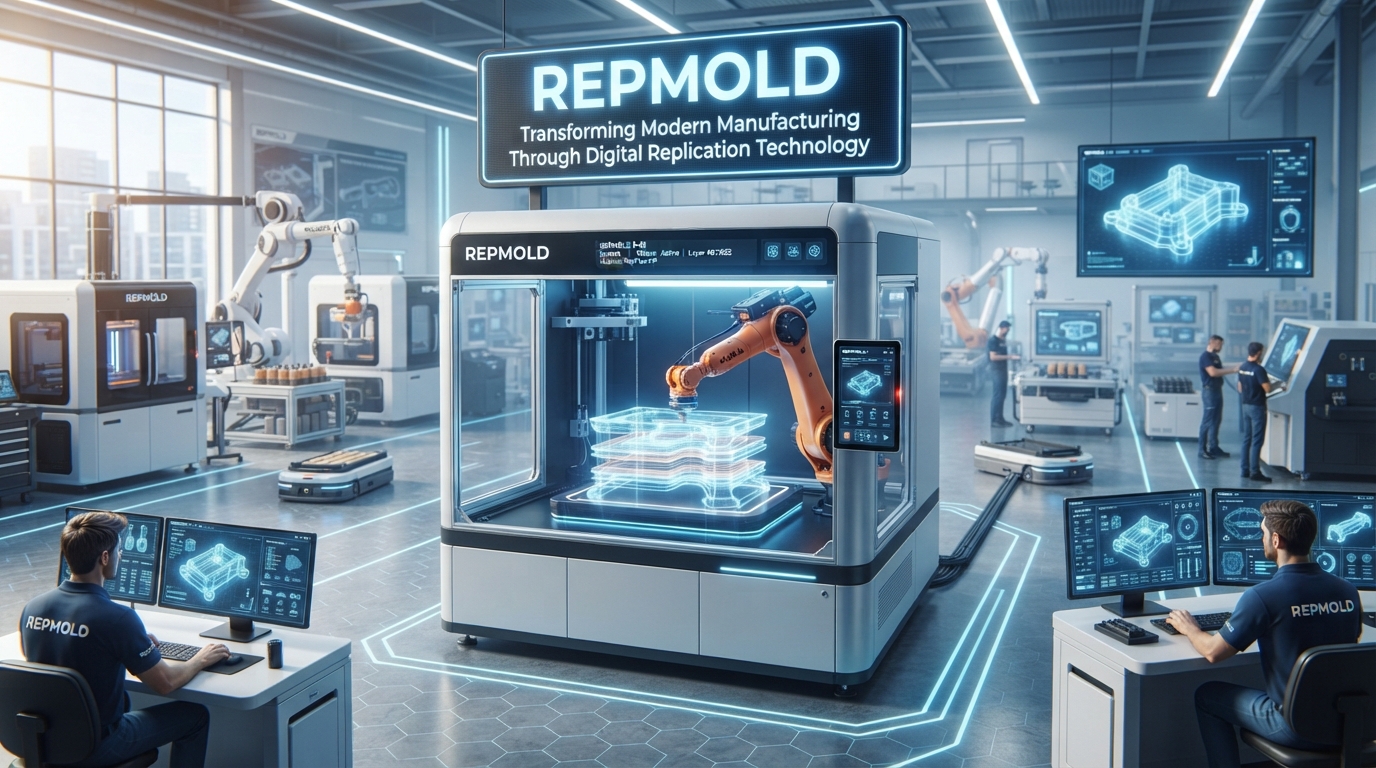
The manufacturing industry has entered a new era where precision, efficiency, and speed define competitive success. Among the concepts contributing to this transformation, repmold has emerged as a digital-driven molding and replication process that enables manufacturers to rapidly design, develop, and reproduce components with remarkable consistency. Rather than relying solely on conventional production methods, this innovative approach combines digital modeling, automated workflows, advanced material science, and intelligent manufacturing systems to create products that meet modern quality standards. As industries continue embracing digital transformation, this manufacturing concept has become increasingly valuable for organizations seeking faster product development cycles, reduced production costs, and enhanced design flexibility.
Manufacturers across multiple sectors are adopting advanced replication technologies because consumer expectations continue to rise. Products must be delivered quickly while maintaining exceptional quality and performance. Digital manufacturing methods provide the foundation for achieving these objectives by integrating computer-aided design, simulation software, automated machining, and quality monitoring systems. The result is a streamlined workflow that minimizes waste, improves accuracy, and accelerates innovation.
The growing emphasis on sustainability has also encouraged companies to rethink production strategies. Modern manufacturing processes increasingly prioritize efficient material usage, reduced energy consumption, and environmentally responsible operations. Digital replication techniques support these objectives by optimizing production planning before physical manufacturing begins, allowing engineers to identify improvements during virtual testing rather than after production.
Repmold as a Foundation for Intelligent Production
Digital manufacturing has evolved beyond simple automation. Today, intelligent production systems combine advanced software with connected equipment capable of communicating throughout every stage of manufacturing. Within this environment, digital replication technologies serve as an important bridge between product design and final production.
Engineers begin by creating highly detailed three-dimensional models that accurately represent every aspect of a component. These digital models become the central reference for simulation, analysis, testing, and manufacturing preparation. By evaluating structural integrity, thermal behavior, material performance, and dimensional accuracy before production starts, manufacturers significantly reduce costly design revisions.
The ability to replicate highly accurate components consistently makes digital molding solutions especially valuable for industries where precision directly influences safety, performance, and regulatory compliance. Automotive manufacturers, aerospace companies, electronics producers, and medical device developers increasingly rely on digitally controlled manufacturing environments to maintain exceptional standards.
Table: Traditional Manufacturing Compared with Digital Replication
| Manufacturing Aspect | Conventional Process | Digital Manufacturing Approach |
|---|---|---|
| Product Design | Manual revisions | Computer-based modeling |
| Prototype Development | Multiple physical samples | Virtual simulation before production |
| Production Accuracy | Operator dependent | Digitally controlled precision |
| Quality Inspection | End-stage inspection | Continuous monitoring |
| Production Speed | Moderate | Significantly faster |
| Material Efficiency | Higher waste | Optimized utilization |
| Product Customization | Limited flexibility | Highly adaptable |
Repmold in Product Design and Engineering Innovation
Modern engineering increasingly depends on digital collaboration between designers, analysts, and production specialists. Advanced modeling platforms enable every stakeholder to work within the same digital environment, ensuring consistency from concept development to mass production.
Virtual design environments support rapid experimentation with dimensions, materials, internal structures, and manufacturing parameters. Engineers can compare multiple design alternatives within hours instead of waiting weeks for physical prototypes. This capability shortens development timelines while encouraging greater creativity and innovation.
Simulation technology further enhances decision-making by predicting how products will perform under different operating conditions. Engineers evaluate stress distribution, vibration behavior, thermal expansion, airflow characteristics, and material fatigue before committing resources to manufacturing. Early identification of potential issues significantly improves final product reliability while reducing development expenses.
Digital workflows also simplify communication between global manufacturing facilities. Shared design databases allow teams in different countries to collaborate efficiently without compromising design accuracy. Every revision becomes immediately available throughout the production network, reducing misunderstandings and improving project coordination.
Digital Infrastructure Supporting Repmold
The effectiveness of modern replication technologies depends on an interconnected digital infrastructure. Computer-aided design software forms the foundation by creating precise virtual product models. Manufacturing execution systems coordinate production schedules, while enterprise management platforms integrate inventory, procurement, logistics, and quality assurance into a unified operational framework.
Cloud computing has further expanded manufacturing capabilities by enabling secure access to engineering data from virtually any location. Design teams collaborate in real time, suppliers receive updated specifications instantly, and production managers monitor manufacturing performance through centralized dashboards.
Artificial intelligence increasingly contributes to production optimization by analyzing machine performance, identifying maintenance requirements, and predicting production bottlenecks before they occur. Machine learning algorithms continuously improve manufacturing efficiency by evaluating historical production data and recommending process improvements.
As industrial connectivity expands through smart factories and Internet of Things technologies, manufacturers gain unprecedented visibility into every production stage. Sensors installed throughout production lines collect operational data that supports predictive maintenance, quality improvement, and process optimization.
Repmold Across Modern Industrial Applications
As manufacturing technologies continue evolving, repmold has become increasingly valuable across industries that demand exceptional precision, repeatability, and production efficiency. Digital-driven molding processes are no longer limited to large industrial facilities. Businesses of various sizes are incorporating intelligent manufacturing systems to improve productivity while maintaining consistent product quality. The flexibility of digital replication allows manufacturers to produce both small customized batches and high-volume commercial products with minimal workflow disruption.
The automotive industry represents one of the strongest examples of digital manufacturing adoption. Vehicle manufacturers constantly introduce new models, requiring shorter development cycles and highly accurate production methods. Engineers utilize digital molding technologies to manufacture interior components, dashboard assemblies, lighting systems, structural panels, and numerous precision-engineered plastic parts. Virtual simulations help optimize every component before production begins, reducing manufacturing errors while improving overall vehicle performance.
Aerospace manufacturers also depend on digitally controlled production because even microscopic dimensional variations can influence safety and operational reliability. Components used in aircraft cabins, structural assemblies, ventilation systems, and lightweight composite structures require exceptional consistency. Digital manufacturing environments enable engineers to verify design specifications throughout production, ensuring every replicated component satisfies strict industry standards.
Healthcare organizations increasingly rely on advanced manufacturing technologies to produce medical equipment, laboratory devices, surgical instruments, diagnostic components, and customized healthcare solutions. Digital production workflows improve accuracy while supporting traceability, documentation, and regulatory compliance that remain essential throughout the medical sector.
Consumer electronics manufacturers benefit from rapid product development supported by intelligent replication technologies. Smartphones, wearable devices, computer accessories, household electronics, and smart appliances often contain complex miniature components requiring extremely precise manufacturing tolerances. Digital workflows enable manufacturers to respond quickly to changing consumer demands without sacrificing quality.
Table: Industry Applications of Digital Manufacturing
| Industry | Typical Products | Primary Advantages |
|---|---|---|
| Automotive | Interior panels, lighting, dashboards | Faster production and consistent quality |
| Aerospace | Composite components, cabin parts | High precision and safety compliance |
| Healthcare | Medical devices and laboratory equipment | Accurate manufacturing and trace documentation |
| Consumer Electronics | Device housings and accessories | Miniaturization with excellent consistency |
| Industrial Equipment | Machine components and replacement parts | Improved durability and efficient production |
| Consumer Products | Packaging, household items, decorative products | Flexible manufacturing and reduced waste |
Repmold and Material Innovation
Material science plays an increasingly important role within digitally driven manufacturing systems. Engineers now have access to advanced polymers, reinforced composites, biodegradable materials, engineering plastics, and hybrid compounds specifically designed for modern production technologies. Selecting appropriate materials significantly influences product durability, structural integrity, thermal resistance, appearance, and manufacturing efficiency.
Digital simulation software allows engineers to evaluate material performance before physical production begins. Different materials can be tested under varying environmental conditions, mechanical loads, temperature ranges, and chemical exposures without consuming physical resources. This predictive capability reduces experimentation costs while accelerating product development.
Manufacturers are also investing heavily in environmentally responsible materials. Sustainable polymers, recyclable compounds, and bio-based alternatives support global efforts to reduce industrial waste while maintaining competitive product performance. Digital optimization further minimizes raw material consumption by refining mold geometry and production parameters before manufacturing starts.
The integration of intelligent material databases allows engineers to compare thousands of material properties instantly. Mechanical strength, elasticity, impact resistance, moisture absorption, thermal conductivity, and manufacturing compatibility can all be evaluated during product development, improving engineering decisions throughout the design process.
Repmold and Automation in Smart Factories
The emergence of smart factories has fundamentally transformed manufacturing operations. Advanced automation technologies coordinate machines, robots, sensors, and software platforms to create highly connected production environments capable of continuous optimization.
Industrial robots perform repetitive manufacturing operations with exceptional consistency, reducing production variability while increasing throughput. Automated systems handle component positioning, molding operations, finishing processes, inspection procedures, and packaging with minimal human intervention.
Machine vision systems continuously inspect manufactured products using high-resolution cameras and artificial intelligence. These systems identify dimensional deviations, surface imperfections, color inconsistencies, and structural defects in real time. Instead of discovering quality issues after production completion, manufacturers receive immediate feedback, allowing corrective adjustments during manufacturing.
Predictive maintenance represents another significant advancement within intelligent production environments. Sensors monitor vibration, temperature, pressure, power consumption, and machine performance continuously. Artificial intelligence analyzes this information to identify maintenance requirements before unexpected equipment failures interrupt production schedules.
Cloud-connected manufacturing systems enable factory managers to monitor production performance from virtually any location. Real-time dashboards display operational efficiency, machine utilization, production output, maintenance schedules, and quality indicators, supporting faster management decisions and improved operational transparency.
Digital Design Collaboration Within Repmold
Modern manufacturing increasingly depends upon collaboration between multidisciplinary engineering teams. Product designers, manufacturing engineers, quality specialists, supply chain managers, and production supervisors frequently work together throughout development.
Cloud-based engineering platforms simplify communication by providing centralized access to digital product models. Every authorized team member can review updated designs, recommend improvements, approve modifications, and monitor project progress without geographical limitations.
Version management systems eliminate confusion associated with outdated drawings or inconsistent documentation. Every design revision is securely recorded, ensuring manufacturing teams always work from the latest approved specifications. This structured workflow significantly reduces production errors resulting from documentation inconsistencies.
Simulation-driven collaboration further improves decision-making. Structural analysis, airflow simulations, thermal evaluations, manufacturing feasibility studies, and assembly verification can all occur before physical production begins. As a result, organizations minimize redesign costs while improving overall product quality.
Digital collaboration has become particularly valuable for multinational manufacturers managing production facilities across multiple countries. Standardized engineering databases ensure consistent manufacturing practices regardless of factory location, strengthening product quality throughout global supply chains.
Repmold and Quality Assurance in Modern Manufacturing
Quality assurance has become one of the defining strengths of modern digital production environments. Instead of depending primarily on final product inspection, manufacturers now integrate quality verification throughout every stage of development and production. This proactive approach enables engineering teams to detect inconsistencies before they develop into larger manufacturing issues, improving efficiency while reducing production costs.
Digital monitoring systems continuously collect information from manufacturing equipment, environmental sensors, inspection cameras, and measurement devices. These data streams create a comprehensive picture of production performance, allowing operators to identify trends that may influence dimensional accuracy, surface quality, or structural integrity. Continuous monitoring also supports traceability, making it easier to investigate production history whenever quality improvements are required.
Three-dimensional scanning technologies have become increasingly valuable for dimensional verification. High-resolution scanners compare manufactured components against original digital models, highlighting even minor deviations that may affect product performance. Automated inspection software generates detailed reports that simplify documentation and regulatory compliance.
Artificial intelligence further enhances quality assurance by recognizing manufacturing patterns that humans might overlook. Machine learning algorithms analyze thousands of production cycles to identify relationships between equipment settings, material behavior, environmental conditions, and finished product quality. These insights enable manufacturers to optimize production parameters continuously while maintaining consistent standards.
Table: Digital Quality Management Components
| Quality Function | Digital Solution | Operational Benefit |
|---|---|---|
| Dimensional Inspection | Three-dimensional scanning | Accurate measurement verification |
| Surface Evaluation | Machine vision systems | Early defect identification |
| Production Monitoring | Smart sensors | Continuous operational visibility |
| Data Analysis | Artificial intelligence | Predictive quality improvement |
| Documentation | Digital reporting platforms | Simplified traceability |
| Compliance | Automated record management | Easier regulatory verification |
Repmold and Sustainable Manufacturing Practices
Sustainability has become a strategic objective throughout global manufacturing industries. Organizations increasingly recognize that environmentally responsible production can improve operational efficiency while supporting long-term business growth. Digital manufacturing technologies contribute to sustainability by reducing unnecessary material consumption, minimizing production waste, and optimizing energy utilization.
Virtual product development significantly decreases dependence on multiple physical prototypes. Engineers evaluate design alternatives digitally before manufacturing begins, reducing raw material consumption and shortening development timelines. Fewer prototype iterations translate directly into lower environmental impact while preserving valuable engineering resources.
Optimized mold design further supports efficient production. Computer simulations identify opportunities to improve material flow, reduce excess material usage, shorten cooling cycles, and minimize production defects. These improvements enhance both economic performance and environmental responsibility.
Energy management systems represent another important component of sustainable manufacturing. Connected production equipment continuously monitors electricity consumption, identifying opportunities for efficiency improvements. Intelligent scheduling allows energy-intensive operations to be coordinated more effectively, reducing unnecessary power usage across manufacturing facilities.
Many manufacturers also explore recyclable materials and environmentally friendly polymers suitable for digitally controlled production processes. These alternative materials support circular manufacturing principles while meeting modern performance expectations across numerous industries.
Repmold Within Supply Chain Optimization
Efficient manufacturing depends not only on production technology but also on effective supply chain coordination. Digital manufacturing platforms integrate purchasing, inventory management, logistics, production scheduling, and customer demand forecasting into unified operational systems.
Real-time inventory monitoring enables manufacturers to maintain appropriate material availability without excessive stock accumulation. Intelligent forecasting systems analyze historical demand, seasonal variations, and market trends to improve purchasing decisions while reducing inventory costs.
Production scheduling software coordinates manufacturing resources according to customer priorities, machine availability, material supply, and workforce capacity. This integrated planning minimizes production delays while maximizing equipment utilization throughout the factory.
Supplier collaboration has also improved significantly through digital communication platforms. Updated engineering specifications, production schedules, and quality requirements can be shared immediately with suppliers, ensuring consistency across every stage of the manufacturing process.
Global supply chains benefit from enhanced visibility provided by cloud-connected management systems. Decision-makers can monitor shipments, production progress, inventory levels, and supplier performance in real time, enabling faster responses to unexpected disruptions.
Repmold and Workforce Transformation
Although automation continues expanding throughout manufacturing, skilled professionals remain essential for successful digital production. Rather than replacing human expertise, intelligent technologies reshape workforce responsibilities by emphasizing analytical thinking, engineering knowledge, digital competencies, and continuous improvement.
Modern manufacturing professionals increasingly work alongside collaborative robots, automated inspection systems, advanced simulation software, and artificial intelligence platforms. Engineers focus more on optimizing production strategies, interpreting analytical data, improving workflows, and developing innovative products instead of performing repetitive manual tasks.
Educational institutions and industrial training programs have responded by expanding instruction in computer-aided design, manufacturing simulation, robotics, industrial automation, digital quality management, and data analytics. These interdisciplinary skills prepare future professionals for increasingly sophisticated production environments.
The Digital and Future Industrial Innovation
The future of manufacturing will likely become even more interconnected as digital technologies continue advancing. Artificial intelligence, advanced robotics, cloud computing, digital twins, and next-generation simulation platforms will further improve production efficiency while expanding engineering possibilities.
Digital twin technology is expected to become increasingly influential by creating virtual replicas of manufacturing systems that continuously mirror real-world operations. Engineers will monitor equipment performance, predict maintenance requirements, evaluate production changes, and optimize manufacturing strategies without interrupting physical production.
Advanced artificial intelligence systems will increasingly support autonomous process optimization by analyzing production data continuously and recommending immediate operational improvements. These intelligent systems may eventually adjust manufacturing parameters automatically while maintaining strict quality standards.