
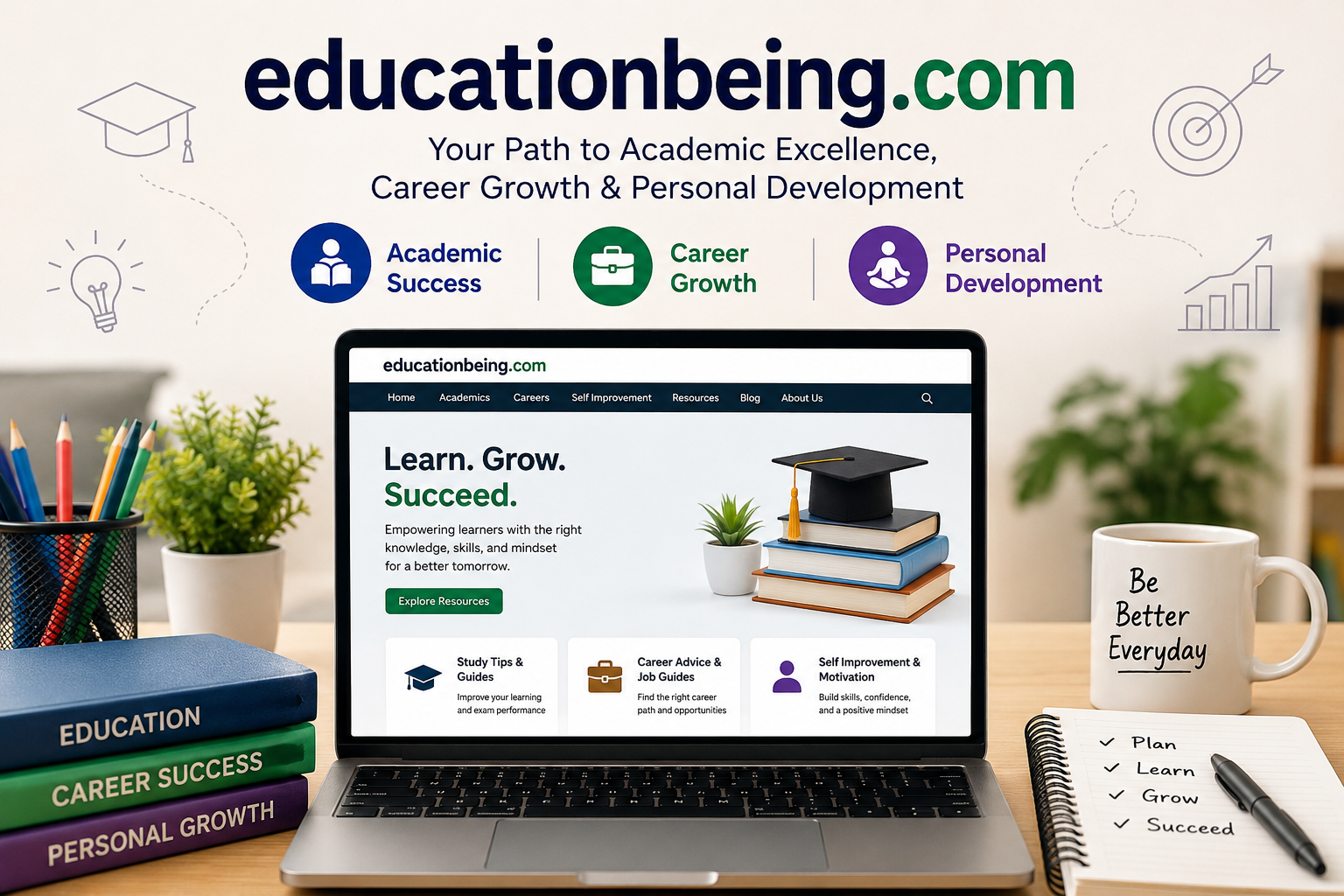
In today’s digital world, students and professionals increasingly rely on online platforms that provide reliable educational resources, practical career advice, and opportunities for personal growth. educationbeing.com is a digital platform focused on academic, career, and self-improvement guidance, designed to help learners navigate their educational journeys while preparing for long-term professional success. By bringing together informative content, learning strategies, career planning resources, and motivational insights, the platform creates a comprehensive environment where users can continuously develop their knowledge and abilities.
Education has evolved beyond traditional classrooms. Learners now seek flexible resources that fit different learning styles, schedules, and professional goals. Digital platforms have become valuable companions for students, graduates, job seekers, and lifelong learners who wish to remain competitive in an ever-changing world. Rather than simply delivering information, modern educational websites encourage critical thinking, practical application, and continuous improvement. This transformation reflects the growing demand for accessible knowledge supported by technology.
The rise of remote learning, digital certification programs, and online career development has significantly changed how people acquire new skills. Learners can now access educational materials from virtually anywhere while balancing work, family, and personal commitments. Platforms dedicated to learning and professional growth bridge the gap between theoretical education and practical career preparation, making education more inclusive and adaptable.
The following table illustrates how digital educational platforms have transformed learning experiences across various areas of development.
| Learning Area | Traditional Approach | Modern Digital Approach |
|---|---|---|
| Academic Learning | Classroom lectures | Interactive online resources |
| Career Development | Career offices | Digital career guidance |
| Skill Enhancement | Physical workshops | Online learning materials |
| Personal Growth | Self-help books | Continuous digital mentoring |
| Professional Networking | Local events | Global online communities |
Digital education has become increasingly personalized. Learners can focus on subjects that match their interests while progressing at their own pace. Personalized recommendations, structured learning paths, and practical examples improve both understanding and long-term retention of knowledge.
The Purpose Behind educationbeing.com
The primary objective of educationbeing.com is to provide meaningful educational guidance that supports learners throughout different stages of life. Instead of concentrating on only one aspect of education, the platform integrates academic success, career planning, and personal development into a unified learning experience.
Students often face challenges such as selecting suitable study methods, managing time effectively, preparing for examinations, and choosing future career paths. At the same time, professionals seek opportunities to improve workplace skills, adapt to technological advancements, and remain competitive in changing industries. A platform that addresses both academic and professional needs creates lasting value for diverse audiences.
One of the strongest characteristics of modern educational platforms is their ability to simplify complex topics. Rather than overwhelming readers with technical language, well-structured articles explain concepts in an understandable manner while encouraging practical implementation. This balanced approach makes learning accessible to individuals with varying educational backgrounds.
The integration of self-improvement content further strengthens the learning experience. Success depends not only on technical knowledge but also on communication skills, confidence, adaptability, emotional intelligence, and lifelong learning habits. These personal qualities significantly influence academic achievement and career advancement.
As educational technology continues evolving, learners benefit from digital environments that encourage continuous improvement instead of short-term memorization. This philosophy helps individuals build sustainable learning habits that remain valuable throughout their professional careers.
Academic Resources Available Through educationbeing.com
Academic excellence requires more than reading textbooks. Students need effective learning strategies, reliable educational materials, and organized study plans that maximize productivity while reducing stress. Digital learning platforms contribute significantly by offering guidance tailored to different educational levels and disciplines.
Modern learners encounter vast amounts of information every day. Identifying trustworthy educational resources has become increasingly important. Platforms focused on education organize valuable content into structured categories, enabling students to locate relevant information efficiently without becoming overwhelmed.
The table below demonstrates how organized academic resources support student success.
| Academic Support Area | Benefits for Learners |
|---|---|
| Study Techniques | Improves knowledge retention |
| Examination Preparation | Builds confidence before exams |
| Time Management | Increases productivity |
| Assignment Guidance | Enhances academic performance |
| Research Skills | Strengthens critical thinking |
Effective academic development involves consistent practice rather than occasional intensive study sessions. Learners who establish regular study routines often experience better comprehension, improved memory retention, and greater confidence during assessments. Digital educational platforms reinforce these habits by providing practical advice that students can apply immediately.
Another valuable aspect of online academic guidance is flexibility. Students may revisit articles whenever necessary, allowing them to reinforce difficult concepts without time limitations. This accessibility supports independent learning while complementing formal education provided by schools, colleges, and universities.
Educational success also depends on motivation. Students frequently experience periods of reduced enthusiasm caused by academic pressure, workload, or uncertainty regarding future goals. Informative educational platforms encourage perseverance by sharing practical techniques for overcoming common learning obstacles while maintaining long-term focus.
educationbeing.com and Career Development Opportunities
Career development has become an ongoing process rather than a single decision made after graduation. Employers increasingly seek individuals who demonstrate adaptability, practical knowledge, communication skills, and a willingness to continue learning throughout their careers. educationbeing.com addresses this reality by offering guidance that helps learners prepare for professional success while adapting to changing workplace expectations.
Career planning begins with understanding personal interests, strengths, and long-term ambitions. Many students struggle to choose suitable academic pathways because they lack reliable information about different industries and employment opportunities. Access to well-organized career guidance enables learners to compare professions, evaluate required qualifications, and make informed decisions that align with their personal goals.
The transition from education to employment can be challenging. Graduates often possess theoretical knowledge but require additional preparation in areas such as interview techniques, résumé writing, workplace communication, and professional etiquette. Digital career resources bridge this gap by presenting practical advice that complements formal academic education.
The following table highlights several important areas of career preparation supported by digital learning platforms.
| Career Development Area | Importance for Professional Growth |
|---|---|
| Career Exploration | Helps identify suitable professions |
| Resume Development | Improves job application quality |
| Interview Preparation | Builds confidence during recruitment |
| Professional Communication | Enhances workplace relationships |
| Skill Development | Supports long-term employability |
Modern workplaces continue evolving due to automation, digital transformation, and globalization. Employees who regularly update their knowledge remain better prepared to adapt to industry changes. Continuous learning has become a valuable habit rather than an optional activity, making educational platforms increasingly relevant for professionals at every career stage.
Career guidance also encourages realistic goal setting. Rather than pursuing opportunities without direction, learners benefit from structured planning that identifies achievable milestones while remaining flexible enough to accommodate changing circumstances. Small, consistent improvements often produce greater long-term success than attempting rapid progress without preparation.
Employers value candidates who demonstrate curiosity, problem-solving ability, teamwork, and effective communication. These qualities complement technical expertise and contribute to stronger workplace performance. Educational resources that emphasize both professional knowledge and personal development prepare individuals for sustainable career advancement rather than short-term employment.
Self-Improvement as a Foundation for Lifelong Learning
Self-improvement plays an essential role in both personal satisfaction and professional achievement. Academic qualifications provide valuable knowledge, but long-term success often depends upon continuous personal growth. educationbeing.com recognizes that learning extends beyond classrooms by encouraging readers to develop habits that strengthen confidence, discipline, resilience, and emotional intelligence.
Individuals who commit themselves to continuous improvement become more adaptable when facing new challenges. Whether learning a new technology, changing careers, or pursuing advanced education, the willingness to improve creates opportunities that may not otherwise exist. Personal development therefore becomes an investment with lasting benefits.
Building productive daily routines contributes significantly to long-term success. Consistent study habits, healthy time management, reflective thinking, and effective goal setting help individuals maintain steady progress even during demanding periods. Small improvements repeated regularly often produce remarkable long-term outcomes.
The relationship between self-improvement practices and personal growth can be summarized in the following table.
| Self-Improvement Habit | Positive Outcome |
|---|---|
| Daily Reading | Expands knowledge |
| Goal Setting | Maintains motivation |
| Time Management | Improves productivity |
| Reflection | Encourages continuous improvement |
| Lifelong Learning | Supports career advancement |
Confidence develops gradually through repeated learning experiences. Every completed course, solved problem, or successfully achieved objective strengthens an individual’s belief in their own abilities. Educational platforms support this process by presenting achievable learning opportunities that encourage consistent progress rather than perfection.
Motivation naturally fluctuates throughout academic and professional journeys. Instead of relying solely on temporary inspiration, successful learners establish systems that keep them moving forward even when enthusiasm decreases. Practical advice regarding habit formation, planning, and self-discipline helps readers maintain momentum toward their long-term objectives.
Personal development also includes emotional well-being. Managing stress, maintaining work-life balance, developing healthy relationships, and improving communication skills contribute to both academic achievement and professional effectiveness. Modern education increasingly recognizes these qualities as essential components of lifelong success.
Digital Learning in the Modern Educational Landscape
Technology has transformed nearly every aspect of education. Traditional classroom instruction now exists alongside online courses, virtual classrooms, educational applications, digital libraries, and interactive learning platforms. These innovations provide learners with greater flexibility while expanding access to quality educational resources across geographical boundaries.
Educationbeing.com environments allow students to study according to their individual schedules without sacrificing educational quality. Recorded lessons, downloadable materials, online assessments, and collaborative discussion spaces support independent learning while maintaining engagement with educational content.
One significant advantage of digital education is accessibility. Learners from different regions can obtain educational materials that might otherwise be unavailable locally. This broader access contributes to educational equality by reducing barriers related to location, transportation, and institutional limitations.
Technology also supports personalized learning experiences. Instead of following identical educational pathways, students can focus on subjects that match their interests, strengths, and career aspirations. Personalized recommendations encourage efficient learning by directing attention toward relevant topics rather than unnecessary material.
As digital education continues expanding, learners increasingly recognize the importance of combining technological tools with critical thinking and practical application. Successful education involves not only acquiring information but also understanding how to analyze, evaluate, and apply knowledge effectively in real-world situations.
How educationbeing.com Supports Skill Development
Skill development has become one of the most important aspects of modern education. Academic qualifications provide foundational knowledge, but employers also value practical abilities that demonstrate readiness for real-world challenges. educationbeing.com encourages learners to strengthen both technical and soft skills, creating a balanced approach to personal and professional growth.
Technical skills continue evolving as industries adopt new technologies and digital solutions. Fields such as information technology, healthcare, business management, biotechnology, engineering, finance, and digital marketing require professionals to update their expertise regularly. Learning platforms simplify this process by offering educational content that introduces emerging concepts while reinforcing essential fundamentals.
Soft skills are equally important because they influence how individuals communicate, collaborate, and solve problems. Effective teamwork, leadership, creativity, adaptability, and emotional intelligence improve workplace performance regardless of industry. Developing these abilities alongside technical knowledge increases employability and career advancement opportunities.
The following table demonstrates the relationship between different categories of skills and their professional benefits.
| Skill Category | Examples | Professional Benefit |
|---|---|---|
| Technical Skills | Software, Data Analysis, Programming | Industry competence |
| Communication Skills | Speaking, Writing, Listening | Better collaboration |
| Leadership Skills | Decision Making, Motivation | Team management |
| Analytical Skills | Critical Thinking, Research | Problem solving |
| Digital Skills | Online Tools, Technology | Workplace efficiency |
Continuous improvement enables learners to remain competitive in an evolving employment market. Rather than viewing education as something that ends after graduation, successful individuals embrace lifelong learning. This mindset encourages curiosity, innovation, and adaptability while preparing learners for future technological and economic changes.
Skill development also contributes to personal confidence. Individuals who consistently improve their knowledge become more comfortable accepting responsibilities, leading projects, and pursuing ambitious goals. Confidence built through competence creates lasting advantages throughout both academic and professional journeys.
The Importance of Time Management in Education
Academic success depends not only on intelligence but also on effective time management. Students often balance lectures, assignments, examinations, extracurricular activities, internships, and personal responsibilities. Without proper planning, these commitments may create unnecessary stress and reduce learning efficiency. educationbeing.com highlights practical strategies that help learners organize their schedules while maintaining productivity.
Effective time management begins with setting realistic priorities. Important academic tasks should receive attention before less urgent activities. Dividing large assignments into smaller sections makes projects more manageable while reducing procrastination.
A structured daily routine creates consistency. Students who dedicate regular study periods each day often retain information more effectively than those who rely on last-minute preparation. Consistency strengthens concentration while improving long-term academic performance.
The following table presents common time management practices and their educational benefits.
| Time Management Practice | Educational Benefit |
|---|---|
| Daily Study Schedule | Consistent learning |
| Goal Planning | Better organization |
| Assignment Calendar | Reduced missed deadlines |
| Revision Sessions | Improved examination performance |
| Break Management | Increased concentration |
Technology also assists with productivity. Digital calendars, reminder applications, task management tools, and online planners enable students to organize academic responsibilities efficiently. When combined with disciplined study habits, these tools significantly improve learning outcomes.
Balancing education with personal well-being remains equally important. Excessive workloads without adequate rest may reduce concentration, motivation, and overall performance. Productive learners recognize the importance of maintaining healthy routines that include sleep, exercise, recreation, and social interaction alongside academic responsibilities.
The Future of Digital Education and Online Learning
Education continues evolving as technological innovation reshapes how knowledge is created, shared, and applied. Artificial intelligence, virtual classrooms, interactive simulations, adaptive learning systems, and cloud-based educational resources are transforming learning experiences worldwide. Platforms similar to educationbeing.com reflect this transformation by making educational guidance more accessible than ever before.
Artificial intelligence increasingly personalizes learning experiences by analyzing student progress and recommending suitable educational materials. Personalized learning paths allow individuals to focus on areas requiring improvement while advancing more quickly through familiar topics.
Virtual classrooms have expanded educational opportunities across geographical boundaries. Students can participate in lectures, workshops, and collaborative discussions regardless of their physical location. This flexibility supports lifelong learning while encouraging international academic collaboration.
The following table outlines several emerging educational technologies and their potential impact.
| Emerging Technology | Educational Impact |
|---|---|
| Artificial Intelligence | Personalized learning |
| Virtual Classrooms | Global accessibility |
| Learning Analytics | Performance tracking |
| Mobile Learning | Flexible education |
| Interactive Simulations | Practical understanding |
educationbeing.com also supports environmental sustainability by reducing paper consumption and minimizing transportation requirements associated with traditional classroom attendance. Electronic resources allow students to access textbooks, research materials, and assignments while reducing reliance on printed documents.
As educational technology advances further, successful learners will combine digital tools with independent thinking, creativity, ethical decision-making, and effective communication. These qualities remain essential regardless of technological progress and continue to define academic and professional excellence.
Building a Growth Mindset Through Continuous Learning
One of the most valuable characteristics developed through education is a growth mindset. Individuals who believe their abilities can improve through consistent effort approach challenges differently from those who view intelligence as fixed. They embrace learning opportunities, accept constructive feedback, and remain motivated despite temporary setbacks.
Continuous learning encourages resilience. Academic difficulties, professional challenges, and unexpected obstacles become opportunities for improvement rather than reasons to quit. This perspective strengthens long-term achievement while supporting both personal satisfaction and career success.
A growth mindset also promotes curiosity. Curious learners actively seek new information, ask thoughtful questions, and explore different perspectives before forming conclusions. These habits strengthen critical thinking while encouraging innovation across academic disciplines and professional environments.
Educational platforms that encourage lifelong learning contribute significantly to this mindset by presenting knowledge as an ongoing journey instead of a destination. Learners who continuously expand their understanding remain prepared for changing industries, evolving technologies, and future career opportunities.