
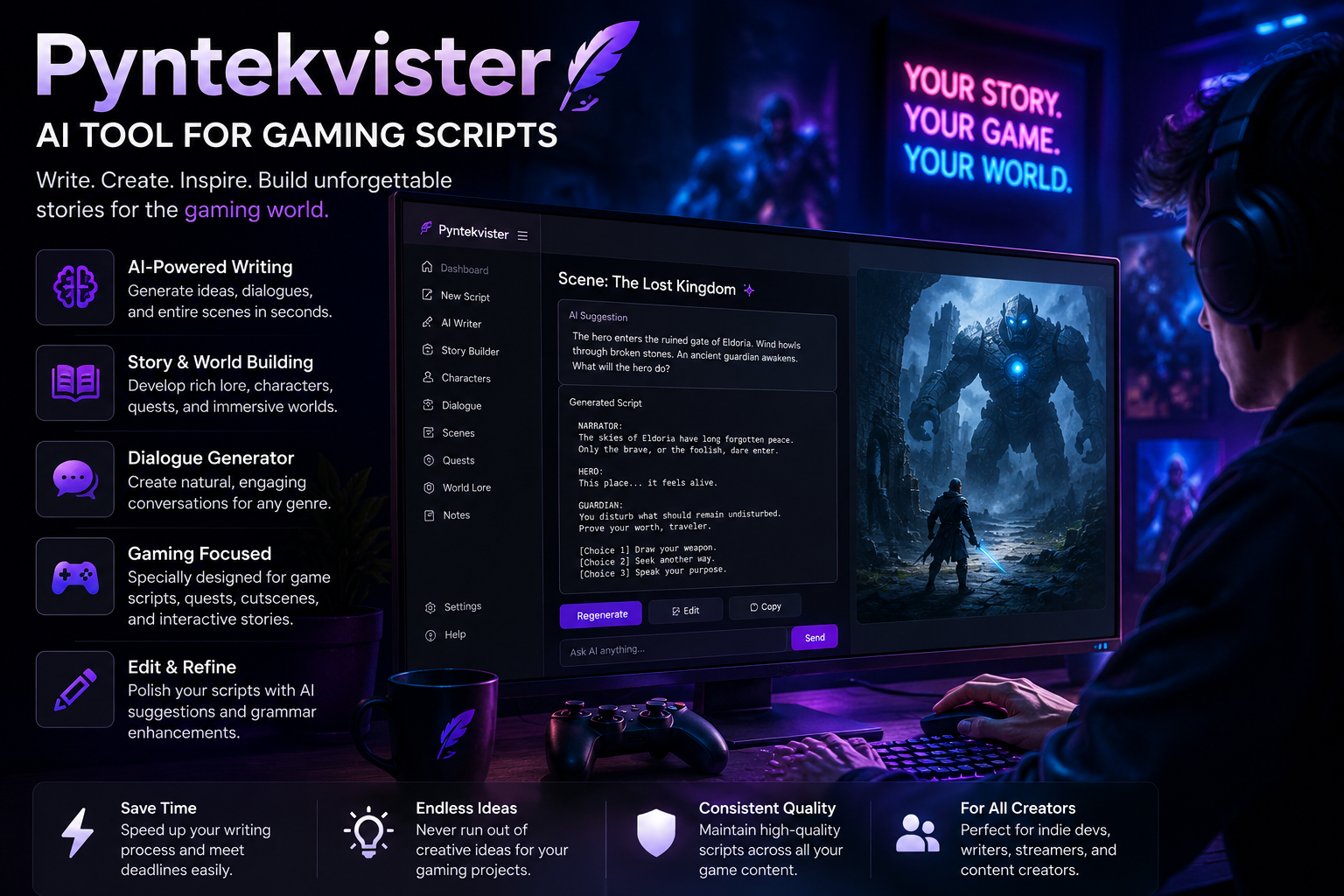
The gaming industry has transformed into one of the most influential entertainment sectors in the world, creating demand for captivating stories that keep players and viewers engaged. Whether scripts are written for video games, gaming YouTube channels, live streams, esports commentary, or interactive experiences, quality storytelling plays an essential role in audience retention. Pyntekvister is an AI-powered platform designed to assist scriptwriters in developing gaming-related scripts with greater speed, creativity, and consistency. Instead of replacing human imagination, the platform functions as a collaborative writing assistant that simplifies brainstorming, dialogue creation, scene planning, and narrative organization while allowing writers to maintain their own creative vision.
Pyntekvister often face tight deadlines while attempting to produce fresh and entertaining content. As gaming genres continue expanding across action, adventure, simulation, strategy, horror, and role-playing experiences, creating unique scripts becomes increasingly demanding. AI writing assistants help reduce repetitive work, allowing writers to dedicate more time to creativity and storytelling. Through intelligent language generation, structured writing support, and adaptable content suggestions, the platform contributes to a smoother production process suitable for beginners as well as experienced gaming writers.
| Feature | Benefit for Scriptwriters |
|---|---|
| AI Writing Assistance | Generates structured script ideas quickly |
| Story Development | Expands narratives with logical progression |
| Dialogue Suggestions | Produces engaging character conversations |
| Editing Support | Improves grammar, clarity, and readability |
| Creative Brainstorming | Helps overcome writer’s block |
| Workflow Optimization | Saves time during script development |
Pyntekvister as a Modern Creative Writing Companion
pyntekvister requires balancing storytelling, gameplay mechanics, emotional pacing, and audience engagement. A successful script must entertain while supporting the overall gaming experience. This process involves extensive planning, character development, environmental descriptions, mission progression, and meaningful dialogue.
Artificial intelligence introduces new possibilities by analyzing writing patterns and generating suggestions based on user prompts. Rather than producing identical content repeatedly, AI-assisted platforms can provide multiple creative directions that writers refine according to their personal style. This collaborative workflow improves efficiency while preserving originality.
Gaming creators frequently produce content across several formats, including gameplay walkthroughs, cinematic cutscenes, lore explanations, game reviews, character biographies, livestream narratives, and educational gaming videos. Each format demands a slightly different writing approach, making flexibility one of the most valuable characteristics of an AI writing assistant.
Pyntekvister appreciate tools that organize ideas before drafting begins. Instead of starting from a blank page, they can develop outlines, scene transitions, character interactions, and dialogue sequences more efficiently. This structured approach reduces unnecessary revisions while maintaining narrative consistency throughout the project.
How Pyntekvister Supports Gaming Storytelling
Pyntekvister differ significantly from traditional novels or films because they often include player interaction, branching narratives, and dynamic environments. Scriptwriters must anticipate multiple scenarios while ensuring every storyline remains engaging.
AI-powered writing assistance simplifies these challenges by helping organize complex narratives into manageable sections. Writers can experiment with alternative story paths, compare dialogue variations, and improve pacing without rewriting every section manually.
Character personalities also benefit from structured development. Heroes, villains, supporting characters, merchants, companions, and mysterious non-playable characters each require distinctive voices. Consistent dialogue strengthens immersion while making every interaction feel authentic within the fictional universe.
Story pacing remains another important factor. Fast-paced action sequences require concise dialogue, whereas emotional scenes often depend upon thoughtful conversations and descriptive storytelling. AI-generated recommendations provide inspiration that writers can modify according to their intended emotional tone.
Interactive storytelling has become increasingly important as modern games encourage player choice. Well-organized scripts allow branching narratives to remain coherent despite multiple possible outcomes. By assisting with structure and continuity, intelligent writing platforms reduce the complexity of managing numerous story variations.
Creative Workflow Improvements Through Intelligent Automation
Every professional scriptwriting project follows several stages, beginning with idea generation before progressing toward outlining, drafting, editing, revision, and final polishing. Many writers spend considerable time organizing information rather than writing itself.
Automation reduces repetitive tasks by assisting with structural formatting, grammar improvement, vocabulary suggestions, and dialogue refinement. These enhancements allow creators to concentrate on creativity instead of technical corrections.
The planning stage often determines the quality of the finished script. Organized outlines help maintain consistent pacing while preventing forgotten plot points. Writers can map entire gaming campaigns before expanding individual scenes, resulting in stronger narrative flow from beginning to end.
Efficient workflows also benefit collaborative projects. Many gaming productions involve multiple writers, editors, voice actors, developers, and creative directors. Standardized script formatting improves communication between departments while reducing misunderstandings during production.
Furthermore, AI-assisted editing provides immediate feedback regarding sentence clarity, readability, repetition, and overall organization. Writers remain fully responsible for creative decisions while using intelligent recommendations to polish their work into professional-quality scripts.
Pyntekvister for Diverse Gaming Content Creation
Pyntekvister has expanded well beyond traditional video games. Today, scriptwriters create material for livestreams, esports broadcasts, game trailers, lore videos, character introductions, educational gaming channels, podcasts, and promotional campaigns. Every format requires a different tone while maintaining audience engagement. Pyntekvister provides a flexible writing environment that adapts to these varying requirements, making it easier for creators to produce polished scripts without sacrificing originality.
A script for a horror game, for example, relies on suspense, carefully timed dialogue, and atmospheric descriptions. In contrast, an action game script demands energetic pacing and concise conversations that keep momentum high. Role-playing games require extensive world-building and believable interactions between characters, while strategy games often focus on tactical explanations and mission briefings. An AI-powered assistant helps writers shift between these styles efficiently, providing structure that supports each genre’s unique storytelling needs.
Gaming influencers also benefit from organized scripts that guide video production. Instead of improvising every recording, creators can prepare introductions, gameplay commentary, transition segments, and conclusions that feel natural while remaining informative. This preparation improves production quality and creates a more enjoyable viewing experience for audiences.
| Gaming Content Type | Writing Focus | AI Assistance |
|---|---|---|
| Gameplay Videos | Commentary and pacing | Structured narration |
| Game Reviews | Balanced analysis | Organized content flow |
| RPG Stories | Character development | Dialogue suggestions |
| Esports Scripts | Match explanations | Clear narration |
| Trailers | Dramatic storytelling | Impactful scene planning |
| Tutorials | Step-by-step guidance | Readable instructional text |
Building Memorable Characters with Pyntekvister
Compelling characters remain one of the strongest elements of successful gaming stories. Players remember heroes who overcome challenges, villains with believable motivations, and supporting characters who contribute meaningfully to the narrative. Strong personalities transform ordinary gameplay into memorable experiences.
Character creation begins with defining goals, strengths, weaknesses, motivations, and relationships. Once these foundations are established, dialogue becomes more authentic because every conversation reflects individual personality traits. AI-assisted writing can recommend dialogue styles that align with a character’s background while allowing scriptwriters to refine every line according to their creative vision.
Consistency is equally important. Characters should react logically throughout the storyline, even when circumstances change dramatically. Maintaining this consistency across lengthy scripts becomes increasingly difficult as projects grow larger. Intelligent writing support helps organize character information, reducing accidental contradictions and improving continuity.
Pyntekvister frequently include emotional turning points where dialogue carries significant weight. Whether celebrating victory, confronting betrayal, or revealing hidden truths, carefully written conversations strengthen emotional engagement. AI-generated suggestions can inspire multiple versions of important scenes, enabling writers to select the approach that best fits the overall story.
Creating Immersive Game Worlds Through Structured Writing
World-building extends beyond describing fictional landscapes. Successful gaming environments combine history, culture, geography, technology, politics, mythology, and environmental storytelling into a believable setting. Players become immersed when every location feels connected to a larger world with its own internal logic.
Developing these environments requires careful planning. Cities, villages, forests, futuristic laboratories, abandoned ruins, and underground civilizations should all contribute to the narrative rather than existing solely as visual backgrounds. Scriptwriters must describe these locations in ways that inspire designers, artists, voice actors, and developers.
AI-powered writing support assists by organizing descriptive information into coherent sections. Instead of losing track of environmental details, writers can maintain consistency throughout multiple chapters or missions. This organized workflow improves collaboration among development teams while strengthening narrative quality.
Environmental storytelling also includes hidden clues, optional conversations, collectible documents, and background events that enrich player exploration. Thoughtfully written details encourage curiosity while expanding the game’s fictional universe naturally.
As open-world games continue growing in popularity, scriptwriters increasingly develop interconnected stories spanning dozens of hours of gameplay. Structured writing assistance becomes particularly valuable for maintaining continuity across such expansive projects.
Dialogue Development for Interactive Experiences
Dialogue serves multiple purposes within games. Characters communicate objectives, reveal emotions, explain mechanics, establish relationships, and advance the storyline. Poor dialogue can weaken an otherwise outstanding game, while engaging conversations often become memorable moments that players discuss long after completing the story.
Writing natural conversations requires balancing realism with entertainment. Every line should contribute meaningfully to character development or narrative progression. Excessive exposition may reduce immersion, whereas concise dialogue often creates stronger emotional impact.
Interactive games frequently include branching conversations where player choices influence future events. Managing these complex dialogue trees manually becomes increasingly challenging as projects expand. Organized writing workflows simplify the creation of alternative responses while maintaining logical consistency between conversation paths.
Voice acting introduces another consideration. Spoken dialogue should sound natural when performed aloud rather than merely reading well on paper. AI-generated drafts provide useful starting points that writers can adapt for smoother vocal delivery.
Localization also benefits from clear script organization. Games translated into multiple languages require consistent terminology and straightforward dialogue structures that preserve intended meaning across different cultures and audiences.
Overcoming Writer’s Block Through Intelligent Inspiration
Every creative professional occasionally experiences writer’s block. Hours may pass without meaningful progress despite careful planning and strong motivation. These creative obstacles can delay projects, increase stress, and reduce overall productivity.
AI-powered writing assistance offers practical solutions by generating fresh ideas from simple prompts. Instead of replacing creativity, it stimulates imagination through alternative storylines, dialogue variations, mission concepts, and character interactions. Writers remain in complete control while benefiting from continuous inspiration.
Creative experimentation becomes easier when multiple possibilities are available instantly. A writer unsure about a particular scene can compare several narrative approaches before selecting one that aligns with the project’s direction. This flexibility encourages innovation while reducing frustration associated with starting from an empty page.
Productivity also improves because brainstorming sessions become shorter and more focused. Rather than spending hours searching for inspiration, creators can begin refining generated concepts almost immediately. This streamlined workflow supports consistent progress throughout long-term writing projects.
Pyntekvister and Collaboration in Modern Game Development
Game development is rarely the work of a single individual. Successful projects typically involve scriptwriters, narrative designers, developers, artists, animators, sound engineers, voice actors, quality assurance teams, and project managers working together toward a shared vision. Effective communication among these professionals is essential for maintaining consistency throughout production. Pyntekvister supports collaborative writing by helping scriptwriters organize content into clear, structured sections that can be reviewed and refined by every department involved in development.
When scripts are well organized, artists gain a clearer understanding of environmental descriptions, animators can visualize character actions more accurately, and voice actors receive dialogue that reflects each character’s personality. This level of organization minimizes misunderstandings and reduces unnecessary revisions later in the production process.
Collaboration also becomes easier when multiple writers contribute to the same project. Consistent formatting, logical story progression, and centralized documentation allow teams to work efficiently without disrupting narrative continuity. AI-assisted organization helps maintain this consistency even as projects grow in complexity.
| Development Stage | Scriptwriter Responsibility | AI Contribution |
|---|---|---|
| Concept Creation | Story planning | Idea generation |
| Narrative Design | Plot structure | Story organization |
| Dialogue Writing | Character conversations | Draft suggestions |
| Editing | Grammar and clarity | Language refinement |
| Team Review | Content revision | Consistency checking |
| Final Production | Polished scripts | Workflow support |
Maintaining Story Consistency Across Long Campaigns
Large-scale games often contain dozens of missions, side quests, optional conversations, and cinematic sequences. As narratives expand, maintaining consistency becomes increasingly difficult. Small contradictions involving character personalities, historical events, or environmental details can reduce immersion and confuse players.
Organized writing systems simplify continuity management by helping writers document important story elements before drafting begins. Character relationships, world history, major conflicts, mission objectives, and important dialogue can remain consistent throughout every stage of development.
Role-playing games present a particularly demanding challenge because player choices frequently influence future events. Branching narratives require multiple dialogue paths while ensuring each storyline remains logical. AI-powered writing assistance helps scriptwriters visualize these narrative branches more efficiently, making complex storytelling easier to manage.
Consistency also extends beyond dialogue. Terminology, fictional locations, technology names, magical systems, and historical references should remain uniform across every chapter. Well-structured documentation supports this objective while improving collaboration between narrative teams.
The Importance of Editing and Revision
The first draft of any script is only the beginning of the creative process. Professional writers understand that editing transforms good ideas into exceptional storytelling. Every revision improves clarity, pacing, dialogue quality, and emotional impact.
Editing begins with evaluating overall story structure before focusing on sentence-level improvements. Writers examine whether scenes appear in a logical sequence, whether characters behave consistently, and whether dialogue advances the narrative effectively. AI-assisted editing provides immediate suggestions regarding readability, grammar, sentence variation, and repetitive wording, enabling creators to identify opportunities for refinement more efficiently.
Revision also includes balancing exposition with action. Excessive explanation may interrupt gameplay, while insufficient context can leave players confused. Finding the appropriate balance requires careful editing supported by organized workflows and objective evaluation.
Creative Flexibility for Multiple Gaming Genres
The gaming industry encompasses an extraordinary variety of genres, each requiring unique storytelling techniques. Action games prioritize momentum and excitement, horror titles emphasize suspense and psychological tension, simulation games focus on realism, while role-playing adventures encourage deep emotional investment through extensive character development.
Flexible writing tools enable scriptwriters to transition between these genres without rebuilding their creative workflow from the beginning. AI-generated suggestions can adapt to different storytelling styles while preserving the writer’s individual voice.
Science fiction narratives often involve futuristic technology, artificial intelligence, and space exploration. Fantasy adventures explore magical kingdoms, mythical creatures, and legendary heroes. Mystery games rely on carefully placed clues, believable investigations, and unexpected plot twists. Educational games require clear explanations presented in an engaging manner.
Cross-genre storytelling has also become increasingly popular. Many modern games successfully combine action, survival, exploration, role-playing, puzzle solving, and emotional storytelling into a single experience. Managing these interconnected elements requires thoughtful planning and organized writing practices.
Future Trends in AI-Assisted Scriptwriting
Artificial intelligence continues evolving rapidly, introducing new possibilities for creative professionals across the entertainment industry. Future writing assistants will likely become even more capable of understanding narrative context, emotional pacing, and audience preferences while supporting increasingly sophisticated storytelling techniques.
Interactive storytelling may become more personalized as AI helps writers design adaptive narratives responding dynamically to player decisions. Procedural dialogue generation, intelligent quest design, and context-aware character interactions could further expand creative opportunities without eliminating the importance of human imagination.
Voice synthesis, virtual production, and advanced animation technologies are also influencing script development. Writers increasingly collaborate with tools capable of supporting multiple stages of content creation, from initial brainstorming to final production documentation.
Despite these technological advancements, creativity remains fundamentally human. AI excels at organization, suggestion generation, and workflow optimization, but original storytelling continues to depend upon imagination, emotional understanding, cultural awareness, and artistic judgment. Successful creators use intelligent tools as collaborative partners rather than replacements for their own creative abilities.