
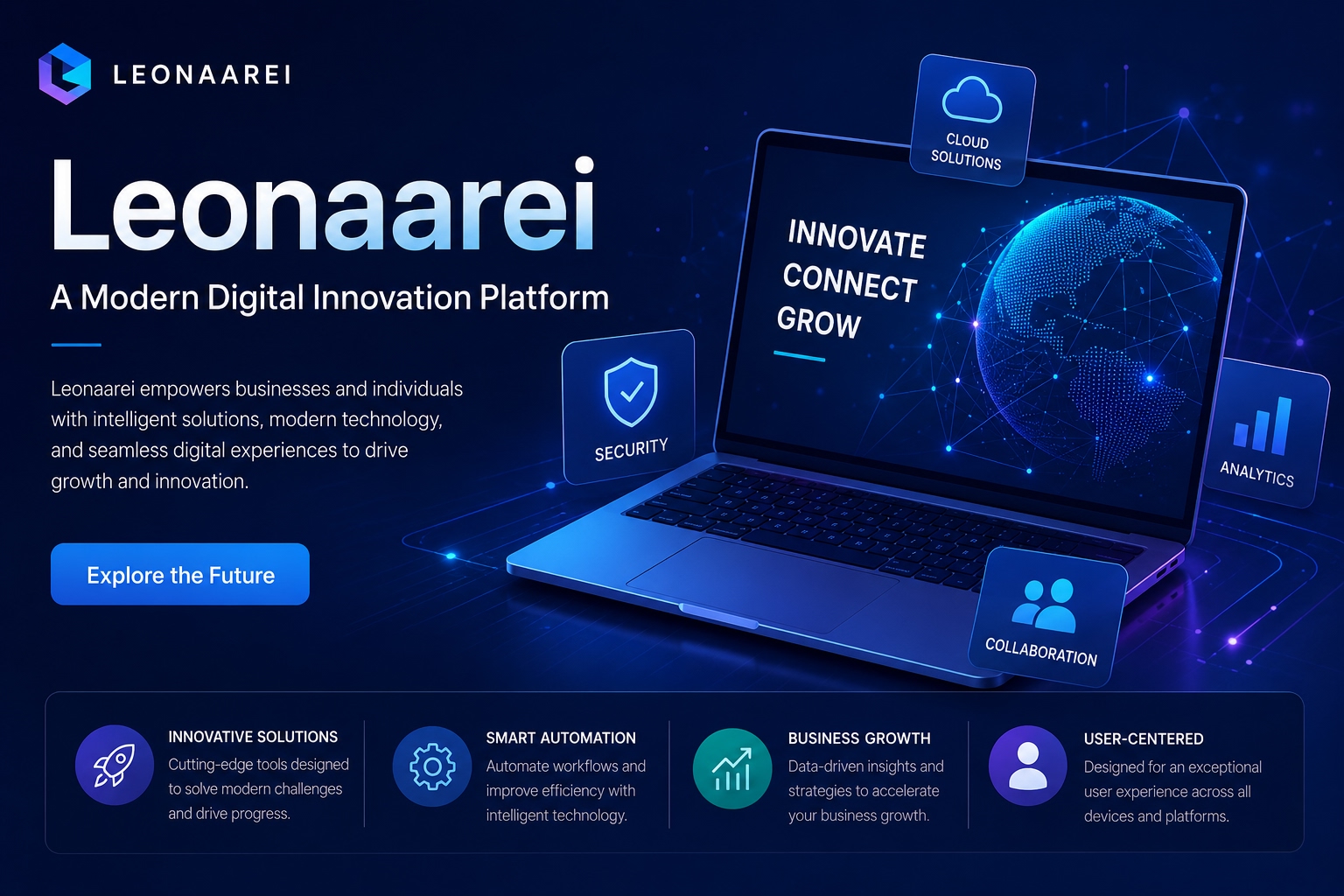
The digital world continues to transform the way individuals, businesses, and organizations communicate, create, and innovate. Among emerging concepts gaining attention is leonaarei, a modern digital platform concept associated with technological advancement, creative solutions, and intelligent online experiences. As technology becomes increasingly integrated into everyday life, platforms that encourage efficiency, adaptability, and user-focused innovation continue to shape the future of digital interaction. Understanding how leonaarei fits into this evolving environment provides valuable insight into the broader movement toward smarter digital ecosystems.
Rather than focusing on a single industry, modern digital platforms are increasingly designed to support multiple sectors simultaneously. Businesses seek flexible environments where collaboration, automation, data management, and customer engagement operate together within one connected framework. The concept represented by this keyword reflects that trend by emphasizing scalability, performance, and continuous innovation.
| Key Information | Description |
|---|---|
| Primary Focus | Digital innovation and online solutions |
| Industry | Technology and Digital Services |
| Core Objective | Improve efficiency and user experience |
| Target Users | Businesses, professionals, creators, and organizations |
| Long-Term Vision | Sustainable digital transformation |
Understanding the Purpose of Leonaarei
Every successful digital initiative begins with a clear purpose. Modern platforms are no longer developed simply to provide online access. Instead, they aim to simplify complex processes, encourage collaboration, improve productivity, and create meaningful digital experiences. This philosophy represents the foundation upon which innovative technology ecosystems continue to evolve.
Organizations increasingly rely on intelligent digital infrastructures to manage projects, communicate with customers, organize information, and analyze operational performance. As industries continue embracing digital transformation, adaptable systems become more valuable because they reduce complexity while supporting future expansion.
| Digital Priority | Business Impact |
| Automation | Saves operational time |
| Cloud Integration | Improves accessibility |
| Security | Protects sensitive information |
| Analytics | Supports informed decisions |
| Scalability | Enables long-term growth |
Leonaarei and the Evolution of Digital Technology
Digital technology has experienced extraordinary progress during the past two decades. Earlier systems primarily focused on storing information and performing basic communication tasks. Today’s digital environments integrate artificial intelligence, cloud computing, machine learning, automation, cybersecurity, and advanced analytics into unified ecosystems capable of supporting millions of users simultaneously.
This technological evolution has encouraged organizations to modernize their infrastructure in order to remain competitive. Businesses increasingly recognize that success depends not only on products and services but also on the quality of their digital experiences. Faster systems, intelligent automation, personalized customer interactions, and efficient workflows contribute significantly to organizational growth.
Core Characteristics of Leonaarei
Successful digital ecosystems share several common characteristics that contribute to long-term sustainability. Flexibility remains one of the most important because technological requirements continuously evolve. Systems designed with modular architectures can adapt more easily to changing business needs without requiring complete redevelopment.
Security represents another essential characteristic. As organizations increasingly process sensitive information online, maintaining strong protection against cyber threats becomes a fundamental responsibility. Encryption, authentication, continuous monitoring, and secure cloud infrastructure help create trusted digital environments.
User experience also plays a significant role in modern technology. Intuitive interfaces reduce learning curves, increase productivity, and improve customer satisfaction. Accessibility, responsive design, and consistent navigation encourage broader adoption across different devices and user groups.
| Core Feature | Practical Benefit |
| Flexible Architecture | Easier future expansion |
| User-Centered Design | Better usability |
| Data Protection | Increased trust |
| Performance Optimization | Faster response times |
| Integration Capability | Improved workflow efficiency |
Digital Innovation Through Leonaarei
Innovation remains one of the strongest drivers of technological advancement. Organizations constantly search for new methods to improve operational efficiency while delivering greater value to customers. Digital innovation involves much more than adopting new software; it includes redesigning business processes, improving communication channels, enhancing customer experiences, and leveraging data to support strategic decision-making.
Modern innovation also depends on collaboration. Cloud-based environments enable teams to work together regardless of geographical location, allowing organizations to access specialized expertise while maintaining productivity. Real-time communication, centralized information management, and intelligent automation contribute to more efficient workflows and stronger organizational performance.
As industries continue embracing digital transformation, innovative platforms increasingly serve as foundations for future growth. Adaptability, continuous improvement, and strategic technological investment allow organizations to remain competitive within rapidly changing markets while preparing for future opportunities that continue to emerge across the global digital economy.
Leonaarei in Modern Business Transformation
Businesses across nearly every industry are adapting to an environment where digital capabilities determine long-term competitiveness. Organizations no longer view technology as a supporting function alone; instead, it has become an essential driver of operational efficiency, customer satisfaction, and strategic planning. Within this context, leonaarei represents a forward-looking approach to digital transformation that values flexibility, innovation, and sustainable growth.
Modern enterprises require systems capable of handling expanding workloads while maintaining reliability and performance. As customer expectations continue to evolve, organizations seek solutions that enable rapid communication, efficient resource management, and seamless digital experiences. The adoption of intelligent technologies helps businesses remain responsive to market changes while improving internal collaboration and productivity.
| Business Area | Digital Improvement |
|---|---|
| Customer Service | Faster response and personalized support |
| Operations | Streamlined workflows and reduced delays |
| Marketing | Better audience engagement through analytics |
| Human Resources | Improved employee collaboration |
| Finance | More accurate reporting and data management |
Leonaarei and User Experience Excellence
One of the defining characteristics of successful digital platforms is the ability to provide an exceptional user experience. Individuals expect online environments to be intuitive, visually appealing, and easy to navigate regardless of the device they use. Meeting these expectations requires careful planning, thoughtful design, and continuous improvement.
Responsive interfaces allow users to interact with digital services comfortably on smartphones, tablets, laptops, and desktop computers. Fast loading speeds reduce frustration while encouraging longer engagement. Accessibility features also ensure that people with different abilities can use digital services effectively, creating a more inclusive online environment.
User-centered design extends beyond appearance. It involves understanding customer behavior, analyzing feedback, and refining features based on real-world usage. Organizations that prioritize usability often experience stronger customer loyalty and improved brand reputation because visitors can accomplish their goals with minimal effort.
Digital Security Within Leonaarei
As digital services continue expanding, cybersecurity has become a critical component of every successful technology strategy. Organizations manage increasing volumes of confidential information, making strong security measures essential for protecting users and maintaining trust.
Security begins with responsible data management. Encryption technologies help safeguard sensitive information during storage and transmission, while authentication systems verify user identities before granting access to protected resources. Regular monitoring further strengthens protection by identifying unusual activities before they develop into significant security incidents.
Modern organizations also recognize the importance of educating employees about cybersecurity practices. Even advanced technical defenses become less effective if users unknowingly expose systems to avoidable risks. Training programs, secure password policies, and awareness campaigns contribute to a stronger security culture throughout an organization.
| Security Component | Organizational Benefit |
| Encryption | Protects confidential information |
| Authentication | Prevents unauthorized access |
| Continuous Monitoring | Detects potential threats early |
| Secure Backups | Supports disaster recovery |
| Security Training | Reduces human error |
Data Analytics and Intelligent Decision-Making
Information has become one of the most valuable organizational assets in the digital economy. Businesses collect data from customer interactions, operational processes, financial activities, and market trends. Proper analysis transforms this information into actionable insights that support better strategic decisions.
Advanced analytics help organizations identify emerging opportunities, monitor performance indicators, and understand customer preferences. Rather than relying solely on assumptions, leaders can use evidence-based insights to guide investments, improve products, and optimize business operations.
Artificial intelligence further enhances analytics by identifying patterns that might remain unnoticed through traditional analysis. Predictive models assist organizations in forecasting demand, improving inventory management, and recognizing potential operational challenges before they affect business performance.
| Analytics Function | Business Value |
| Customer Analysis | Better understanding of user behavior |
| Performance Monitoring | Improved operational efficiency |
| Predictive Insights | More accurate planning |
| Market Evaluation | Enhanced competitive strategy |
| Reporting | Faster executive decision-making |
Leonaarei and Artificial Intelligence Integration
Artificial intelligence has become one of the most influential technologies shaping modern digital environments. As organizations seek faster and more accurate methods of processing information, intelligent systems continue to improve operational efficiency while supporting innovation across multiple industries. Within this evolving landscape, leonaarei reflects the growing importance of combining intelligent automation with user-centered digital experiences.
Artificial intelligence assists organizations by analyzing large volumes of information within seconds, identifying meaningful patterns, and generating valuable recommendations. Businesses can improve customer support through intelligent virtual assistants, optimize internal workflows, and personalize digital experiences according to individual user preferences. These capabilities increase efficiency while allowing employees to concentrate on strategic responsibilities that require creativity and critical thinking.
Machine learning further strengthens intelligent platforms by continuously improving performance through experience. Instead of relying exclusively on predefined instructions, learning algorithms adapt to changing conditions, making digital systems increasingly accurate over time. This continuous improvement creates more responsive services capable of meeting evolving business requirements.
| AI Technology | Organizational Advantage |
|---|---|
| Machine Learning | Improves prediction accuracy |
| Intelligent Automation | Reduces repetitive work |
| Natural Language Processing | Enhances communication |
| Predictive Analytics | Supports planning |
| Recommendation Systems | Personalizes user experiences |
Scalability and Sustainable Growth Through Leonaarei
Every successful organization plans for future expansion. Digital systems must therefore support increasing workloads without compromising performance or reliability. Scalability enables businesses to accommodate additional users, larger databases, and expanding operational requirements while maintaining consistent service quality.
Scalable technology architectures simplify growth because organizations can increase computing resources as demand changes. Instead of replacing entire infrastructures, businesses expand existing capabilities through modular improvements. This flexible approach reduces operational disruption while supporting continuous development.
Sustainability also plays a growing role in technology planning. Organizations increasingly recognize that responsible digital practices contribute to long-term success. Energy-efficient infrastructure, optimized resource utilization, and environmentally responsible computing strategies help businesses reduce operational costs while supporting broader sustainability objectives.
| Growth Factor | Long-Term Benefit |
| Modular Infrastructure | Easier expansion |
| Flexible Resources | Better workload management |
| Sustainable Computing | Reduced environmental impact |
| Cloud Scalability | Efficient resource allocation |
| Continuous Improvement | Greater competitiveness |
The Role of Innovation in Competitive Advantage
Competition within digital industries continues to increase as organizations adopt advanced technologies to improve products and services. Innovation enables businesses to differentiate themselves by introducing creative solutions that address changing customer needs more effectively than traditional approaches.
Innovation also extends beyond technology itself. Improved customer service, streamlined operational processes, sustainable business practices, and enhanced communication strategies all contribute to long-term competitive advantage. Organizations capable of combining technological excellence with exceptional customer experiences often establish stronger market positions.
| Innovation Area | Positive Outcome |
| Product Development | Increased customer value |
| Process Improvement | Greater operational efficiency |
| Customer Experience | Higher satisfaction |
| Research and Development | Continuous technological progress |
| Strategic Planning | Long-term organizational resilience |
Leonaarei and Digital Transformation Across Industries
Digital transformation is no longer limited to technology companies. Today, industries such as healthcare, education, finance, manufacturing, retail, logistics, and entertainment increasingly depend on advanced digital solutions to improve productivity and enhance customer experiences. In this broader environment, leonaarei symbolizes a modern approach to adopting intelligent technologies that encourage innovation while maintaining operational efficiency.
Healthcare organizations utilize digital platforms to improve patient communication, organize medical records, and support remote consultations. Educational institutions integrate online learning environments that encourage collaboration between teachers and students while providing flexible access to educational resources.
Manufacturing companies increasingly adopt smart production systems supported by automation and real-time monitoring. Retail businesses enhance customer engagement through personalized shopping experiences, while logistics organizations optimize transportation networks using advanced analytics and intelligent scheduling technologies.
| Industry | Digital Application | Primary Benefit |
|---|---|---|
| Healthcare | Digital patient management | Improved healthcare delivery |
| Education | Online learning platforms | Greater accessibility |
| Finance | Secure digital banking | Enhanced customer trust |
| Manufacturing | Smart automation | Higher productivity |
| Retail | Personalized shopping | Better customer satisfaction |
| Logistics | Intelligent route planning | Faster delivery operations |
Sustainability and Responsible Innovation Through Digital Innovation Platform
Responsible innovation has become an increasingly important consideration for businesses operating within today’s digital economy. Organizations recognize that technological advancement should balance economic growth with environmental responsibility and social impact.
Energy-efficient computing infrastructure reduces electricity consumption while lowering operational costs. Cloud technologies optimize hardware utilization, minimizing unnecessary resource consumption. Responsible software development practices improve system performance while reducing computational waste.
| Sustainability Practice | Organizational Impact |
| Cloud Optimization | Lower infrastructure costs |
| Paperless Operations | Reduced resource consumption |
| Energy-Efficient Systems | Improved sustainability |
| Responsible Data Management | Increased customer confidence |
| Ethical Innovation | Stronger public reputation |
Challenges Facing Modern Digital Platforms
Although digital transformation creates significant opportunities, organizations also encounter challenges that require thoughtful planning and effective management. Rapid technological advancement demands continuous investment in infrastructure, employee training, and cybersecurity improvements.
Data privacy remains one of the most significant concerns. Businesses must comply with evolving regulatory requirements while ensuring customer information remains secure throughout collection, storage, and processing activities. Failure to maintain strong security standards can damage organizational reputation and reduce customer trust..
Financial considerations also influence digital transformation initiatives. While technological investments often produce long-term benefits, organizations must balance implementation costs with expected returns. Strategic planning ensures resources are allocated effectively while supporting sustainable growth objectives.
Future Opportunities for Digital Innovation Platform
As digital innovation continues to accelerate, organizations that embrace adaptable technologies will be better positioned to respond to changing customer expectations and market demands. The concept behind leonaarei aligns with this vision by emphasizing flexibility, continuous improvement, and responsible technological advancement. Rather than focusing on current requirements, modern digital ecosystems are designed to support future expansion without sacrificing performance or user satisfaction.
Emerging technologies such as artificial intelligence, edge computing, blockchain, the Internet of Things, and advanced cybersecurity solutions will continue influencing digital strategies across industries. Businesses that remain open to innovation while maintaining ethical standards can create lasting competitive advantages. Continuous investment in research, employee development, and digital infrastructure enables organizations to adapt confidently as new opportunities arise.
| Emerging Technology | Future Business Value |
|---|---|
| Artificial Intelligence | Smarter automation and decision-making |
| Edge Computing | Faster processing and lower latency |
| Internet of Things | Connected devices and real-time monitoring |
| Blockchain | Improved transparency and trust |
| Advanced Cybersecurity | Stronger protection against evolving threats |
Building Long-Term Value Through Digital Innovation Platform
Long-term success in the digital economy depends on more than adopting the latest technology. Organizations must create environments that encourage collaboration, continuous learning, innovation, and customer satisfaction. Sustainable growth results from balancing technological progress with responsible leadership and strategic planning.
Investing in scalable infrastructure allows organizations to expand operations without major disruptions. Likewise, maintaining a customer-focused mindset ensures that products and services continue to evolve according to real user needs. These combined efforts strengthen organizational reputation while creating lasting value for stakeholders.
| Strategic Focus | Long-Term Advantage |
| Innovation | Sustainable growth |
| Customer Experience | Increased loyalty |
| Digital Security | Greater confidence and trust |
| Workforce Development | Higher productivity |
| Scalable Infrastructure | Business continuity |
Conclusion
The continuing evolution of digital technology highlights the importance of adaptable, secure, and innovative platforms capable of supporting long-term organizational success. Leonaarei represents a modern digital concept centered on intelligent transformation, cyber security, user-focused design, operational efficiency, and sustainable growth. As organizations increasingly embrace cloud computing, artificial intelligence, advanced analytics, and secure digital infrastructures, the need for flexible technology ecosystems will continue to expand.
Successful digital transformation depends not only on advanced tools but also on strategic leadership, continuous learning, and responsible innovation. Organizations that prioritize collaboration, cybersecurity, customer experience, and scalability are better equipped to thrive within competitive global markets. By investing in modern digital practices and maintaining a commitment to continuous improvement, businesses can strengthen resilience, improve operational performance, and create meaningful value for customers and stakeholders alike.